Showing posts with label bicycle racing. Show all posts

Monday, May 16, 2011

Llora giraldilla mora

Ninety one years ago Spain mourned the death of a young matador in Talavera de la Reina. Jose Gomez Ortega, aka Gallito or Joselito, was twenty-five years old when he died in the afternoon of May 16, 1920. His death deeply affected the whole nation.

Giralda, Sevilla

This week Belgium lost a very popular 26 year old racer named Wouter Weylandt due to an accident in the Giro d'Italia. The impact on the cycling community was equally enormous.

While it may surprise many of you, there are a lot of parallels between bullfighting in Spain and bike racing in Belgium. I pointed this out before when I discussed the kermis and the role of the bike race in the kermis rituals.

While many like to see a bike race as a competitive event where young men try to outdo one another, its origins are quite different. The bike race as originally conceived was a battle of man against the unforgiving forces of nature with survival and domination as its ultimate goal. Henri Desgrange, founder of the Tour de France, thought the ideal race was one with one finisher, one survivor. His Tour de France sent riders over long distances, bad roads, and unforgiving mountain passes to find the hero who would prevail in the end.

The bike race in Flanders, as exemplified by the Ronde is a struggle to survive. A struggle against the dark forces of nature that, in this part of the world are represented by fog, rain, sleet, snow and impassable cobblestone roads. This is punishment on a grand scale.

The battle of man against nature

It is also the daily battle the denizens of Northern Europe fought for centuries in order to survive. The opening scenes of the Ronde video in the Ronde van Vlaanderen Centrum show it very clearly. When the pale sun rises over foggy meadows exposing the wet, icy cobbles you can see that the stage is set for an epic (to the death) battle of man against nature.

The motto of the exhibits stresses blood, guts and glory. This is not so different from the bullfight where the matador confronts death in order to tame the wild forces of nature, in that part of the world represented by the toro bravo, the wild bull.

Both festivities carry an enormous cultural significance in their respective communities. Unfortunately these days many people choose to focus on extraneous details and good looks while ignoring the deep symbolism these events carry. Bike racing in Flanders is first and foremost about survival, honor, character and grit. It is like one Sports Illustrated article said, like boxing in America.

Thursday, May 5, 2011

Deejay Tom Boonen

In this waiting period on the pro cycling calendar, headlines consist of new doping discoveries such as Pasquale Muto's positive CERA test; notable returns from doping suspension, such as Davide Rebellin who will fill in for Pasquale at Miche; lawsuits being dropped, such as Lance's suit against Landis (but not UCI's suit); investigations being abandoned, such as the ongoing inquest against Vino, Iban Mayo and Christian Moreni by French authorities -supposedly dropped because UCI won't cooperate and hand over samples; imminent break-ups such as Lotto and Omega Pharma, leaving Gilbert in the middle; cyclocrossers attempting road racing, such as Stybar's first exploits in the vierdaagse van Duinkerken, and classics riders turning into DJ's for the night, such as Boonen and StuBru.

How is that for a run-on sentence?

We also learned that Lars Boom will stay with Rabobank for another three years and that Contador will attempt to win three grand tours in one year -unless UCI stops him that is. UCI meanwhile is also outlawing needles starting on Saturday in what is known as the "No Needle Policy." Needles are already illegal in the US but their use in the European pro-pack is widespread.

Here is a picture of Alistair modeling the new Rocktape jerseys that were kindly provided to us for the Ster van Zuid-Limburg (thanks Greg), but that unfortunately did not reach us in time to be used for the race.

Rocktape jersey
There are three more slots left for the Ster der Vlaamse Ardennen.

Thursday, April 21, 2011

T-1 and counting

First things first: Gilbert won Flèche Wallonne in a most amazing display of power. It was his third victory in a row. Sunday is Liege-Bastogne-Liege, but unfortunately we will be racing (very nearby too) and won't have time to concentrate on that.

You may also have noted that the weather here is nothing short of spectacular. It is just like summer. Temperatures hover between 25 and 30 C (77-86F) and it stays warm well into the night. Yesterday I rode to the Dutch city of Maastricht and at many points along the way I could see thermometers reading 27 and more.

Today is the day before the big race. Last night the guys entertained themselves by playing pranks on one another, something that continued well into the morning. Earlier, John bought a new helmet, Erik got some aero-gloves, and everyone had crepes at a side-walk cafe on the square. Later, they spent some time getting the bikes in order, planning a trip to the laundromat, installing new tires and aerobars. Hunter still hasn't joined us, he had planned to come yesterday but then hit a little snag with his ATM card. He is scheduled to arrive at noon. The guys are going out on a ride now (at 11:00 AM)

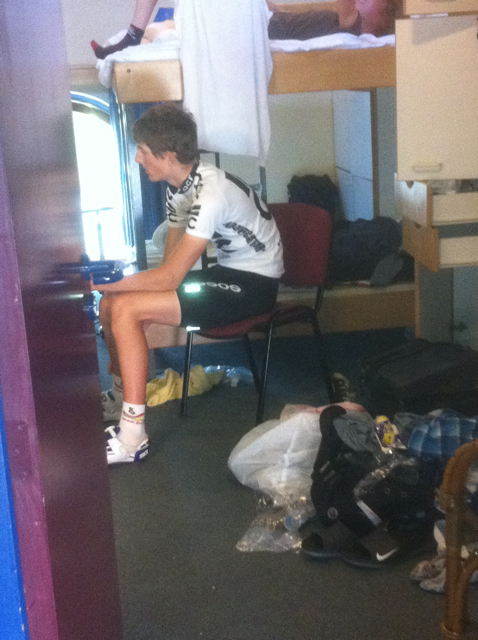
Addison chilling out


Alex reading email

Alistair was out, making him a good target for pranks

Last ride

John

At the Dutch border, I rode here last night, today the guys will go there


Monday, February 7, 2011

Cherry blossoms and beer

The weather has turned sub-tropical with record-setting temperatures in the high 70's to mid- 80's (25-30C) in some places. We are in for a cool down this week but it is supposed to stay dry at least until the weekend. Then some storms are forecast, but every time the forecast gets updated, the storms are downgraded. Right now we expect showers Sunday and Monday.

The weather has produced some very high winds and rather spectacular sunsets. Here is the view from my balcony (a plain iPhone shot with no edits).

Sunset over SF Bay
Spring is definitely in the air. Cherry blossoms are everywhere and many plants are in bloom already. With temperatures like these it feels like mid-May.

Cherry blossoms
Yesterday I went on a 56 mile ride into Danville during the Superbowl. No better time to ride than when all are glued to their TV sets. The one thing that struck me was how different things look on the other side of the hills. There are more deciduous trees there (oaks and maples) and the bare branches impart a distinct wintery look that is in shocking contrast to the flowers around the bay. Bay area microclimates are for real.

Meanwhile my compatriot Stefaan Engels completed his 365 back to back marathons. He had set out on January 1 of 2010 to run a marathon every day of that year but was forced to abandon his effort early on due to a foot problem. He then restarted and now he finished in Barcelona. His best time was 2hrs 56 minutes. Now that is endurance racing at its best.

Sven Nys won his tenth Superprestige and Tommeke scored his first victory of the year in Qatar, where there are as few spectators as in California -but no cows. The big news out of Qatar is that the pro-pack there has decided not to revolt against the no radio rules. Unlike what happened in Mallorca, they decided to keep things quiet. I found this quote from Wilfried Peeters manager of Quickstep who said,  "out of respect for the Sheiks who pump so much money in this race, we're not going to paralyze the thing here." Qatar has plenty of cash-cows apparently.

On Friday, Flanders Classics presented its second edition in Gent in front of former champions Museeuw, Leman and Van Petegem. Flanders Classics has six races, starting with the season opener, Het Nieuwsblad (formerly Het Volk) on February 26 and finishing with the Brabantse Pijl on April 13. The most famous race is the Ronde van Vlaanderen, this year on March 4. Every race in the series has a very popular tourist version the day before. "That way we bring racing closer to the public," the organizers said. The tourist version of the Ronde now attracts more participants than there are amateur racers in the US.

I also wanted to present to you Moinette from the Brasserie Dupont, a fabulous blonde that scored very high in the beeradvocate ranking. Dupont calls it their showpiece. It gets my full support. The Brune (brown) version did not score nearly as high on beeradvocate, but as I mentioned many times before, blondes are my thing. For other Dupont beers, look here.


Moinette blonde


Thursday, May 13, 2010

Bike handling


Cycling is a sport that involves some technique. In road racing for example, we expect the rider to have good bike handling skills. That involves being able to ride in a straight line, hold that line through turns, and be comfortable riding close to other riders. Apart from such basic skills, more advanced skills are also required if one is to do well in a road race. Skills such as taking off and putting on clothing, grabbing food and water bottles, eating and drinking, hopping over obstacles, going down twisty descents, etc.

In mountain biking similar but different skills need to be mastered. Most important there is to distribute one's weight when climbing steep hills with occasional loss of traction. More difficult is hopping logs, riding in gravel or sand, and going around tight turns in mud. Yet these skills can make the difference between winning and finishing in the back.

Most cyclists who start at a young age easily master bike handling skills. Although not all become experts, most will manage to do well enough so biking handling is no limiting factor. Occasionally one will find a pro cyclist who has not mastered a basic skill, but was nonetheless able to reach the pinnacle of the sport. Perhaps the most famous example is Frederico Bahamontes, nicknamed, "The Eagle of Toledo" for his great climbing skills.

Frederico was the best climber of his generation, yet he was afraid of heights and did not descend well. He would often wait at the top of a climb for a friendly rider to join him so they could ride down together. At other times he would get caught on the descent by his competitors. Since Frederico scored his points, and made his fame at the top, this did not matter much.

The situation with respect to basic bike handling is different for cyclists who pick up the sport at a later stage in life. The largest group of those are triathletes, who are infamous for their poor riding skills. Triathletes may not ride in packs or draft for most of their events, and perhaps as a result, many don't know how to ride straight, let alone draft well.

Riding straight is considered the most basic skill a rider can acquire. In countries where people use bicycles for transportation -such as Belgium- all kids are taught to ride straight, whether they become racers or not. Riding straight is a key element in bike safety. Riding straight means suppressing natural reflexes that turn the body whenever the head turns. While such reflexes are useful when walking, doing so while riding is a recipe for disaster. The rider suddenly swerves in the middle of the road.

If you decide to ride a bike for exercise, please learn this one skill. It is more tricky than you think, but it may save your life one day. Learn to ride straight. If you want to proceed to bicycle racing, you will absolutely need to master this, lest you want to go down all the time and take a lot of people with you.

Thursday, February 18, 2010

Natour criteriums, a solution for US cycling's woes?


In my previous post I highlighted some of the problems facing US cycling. Membership in USA Cycling, though growing, is aging fast. There is a lack of enthusiasm among younger people. Cycling is not taken seriously. Schools and colleges do not support it. There is little or no upward mobility or career opportunities.

The sport has gotten tons of bad press due to doping scandals. While nobody complains of baseball players or football players using steroids and other performance enhancing drugs, cyclists are subjected to a real life witch hunt with overly eager officials and the press in tow. While steroid-using baseball players are entered in the hall of fame, cyclists who commit even the smallest misstep are labeled cheaters and their livelihood is threatened or taken away. The anti-doping crowd has muscled its way into their lives with no respect for privacy, let alone civility.

Bike races attract few if any spectators. Races are hidden from view to the extent possible. They happen in remote locations, preferably at the crack of dawn, before anyone hits the street. They present a confusing array of skill levels and age groups, all intermingled on the same road. The various groups often interfere with one another in competition. Scoring is stuck in the 19th century and errors are the rule rather than the exception.

Yet there are some hopeful signs. Lance Armstrong has attained a star status that transcends cycling. Wherever he shows up, impromptu rides materialize and thousands of enthusiasts crowd the streets and bring traffic to a virtual standstill. At the Boston marathon a few years ago, Lance attracted more spectators than race favorites and the rest of the field combined.

The Lance example shows a way forward. What do you do when you want people to follow your lead? You bring out the star power. When the Navy tries to recruit people, they bring out the Blue Angels. They don't show the grunt work or tedium associated with service. They have a simple and straightforward message. Show the excitement and the glory.

US cycling could do the same thing. Even in the crowded (European) calendar there is room for short star-studded races in mid-summer. Mid-summer happens to be the time kids are off from school. Families are on vacation, so every day is a holiday. People crowd scenic venues such as the Sierra's, the wine country, and gold rush towns, ideal locations for afternoon and evening bike races.

US Cycling should help organize natour criteriums (natour is Flemish for "after-tour"). These types of races are held all over Europe right after the Tour de France. They take place in early August, at a time when cycling is front page news but the race calendar is empty. The criteriums are a way for people to see and meet the Tour stars in a smaller and more intimate setting. A way to watch a short but intense race followed by autograph signing and parties. The events are also the best way for professional cyclists to cater to their fan base.

Natour criteriums would be a bonus to US professional teams on their return from Europe. Lance, Levi, Tyler, and others could woe the crowds instead of hiding in the Bahamas or at home. These races would also attract extra crowds to smaller towns in tourist spots, while presenting only a minor inconvenience to local residents. But most importantly, the criteriums would expose children and adolescents to the excitement and glamour of the sport. What better recruiting tool is there?

Tuesday, 9.25 mile loop in the hills
Wednesday, 10.25 mile run to Redwood and back.


Wednesday, October 21, 2009

Barefoot lessons for bike fitting

The NYT had a blogpost addressing the question, "is running barefoot better for you?" The conclusion is rather simple: it does not seem to matter much. Surely you do change your biomechanics when you run barefoot -i.e. you tend to favor toe or at least forefoot striking- but you adapt quickly.

There were several comments however that got me thinking. One reader pointed out that there is no need to make a case that barefoot is better. Barefoot is the default option. The case that needs to be made is whether shoes are of any use. I couldn't agree more. Another reader said your calves will get sore, and those of you who read my blog, know that that too is right. Finally one said, so what, running barefoot is fun. And I couldn't agree more. But that is not all.

I have written extensively about bicycle frame fitting. I have often made the point that it does not matter much and that you can adapt to many different frame sizes and geometries. I know that from personal experience. I also know that none of this affects your performance all that much. The barefoot experience (as documented in the Well blog) seems to strongly support this idea.

Recently, I read an article about fitting in the coaches' newsletter. The argument they made was that fitting is quick, whereas adaptation is slow. In essence they agreed that you can adapt to many frame sizes and geometries, but it takes (a lot of) time and therefore you should get an optimal fit first and you can adapt later. Is that really so?

One key study the Well quotes (published in the British Journal of Sports Medicine last year, so much for a good reference), points out that your landing pattern changes as your shoes wear out and flatten, becoming more barefoot-like. That certainly points to a very dynamic and near-instantaneous response. I.e. your landing pattern changes continuously as your shoes change, from one day to the next.

I would certainly argue that -in my experience- adaptation is very fast. It did not take me very long to get used to a 51 cm frame when I started cycling again after a long break that lasted 4 years. Within a month, I rode the Wildflower triathlon on that frame and did not notice any performance issues. Surely, my bike times were not ideal, but that was due to the short training. I kept riding on that small frame for a long time and got better quickly. The key issue is that I never felt like it stopped me from hammering.

Also, although adaptation is fast, very fast really, it is not instantaneous and it cannot bridge large changes. So you can't train on your road bike and then hammer on your tribike with a different geometry and expect to walk away without being sore (or worse, injured). I also told you the story of John Cobb's bike fit session before CaliforniaMan. Although the changes he made were great and helped in the long run, the fact remains that two days later I was very sore after racing in that new position.

All adaptation takes place over several days and all requires many small steps. You can adjust a little bit every day and bridge large gaps, as long as the whole process is gradual and smooth. Or you can adjust to a large change by starting easy and gradually increasing your exposure. It's all common sense really. Think about it.

Rode KOM 28 miles today. Fun ride!

Monday, August 10, 2009

Back on the bike

Well, it took almost two weeks to get my bike back from Lake Placid. Furthermore, for some unknown reason -and despite a major overhaul at Placid- the stem and handlebars are creaking like crazy again.

On Friday I rode 30 miles to the top of Redwood and back. I felt pretty tired but OK. On Saturday I rode 90 miles to Livermore and that really got me wasted, but yesterday I managed to ride 40 and feel pretty good. Maybe I need more miles. Anyhow, I decided to take it easy today and swim for about an hour. Unlike other times, I did not swim continuously but instead focused on technique.

I am getting the hang of swimming while breathing every other stroke. As for left breathing, that still needs a lot work and I can't seem to get it right.

Alistair did his first race in Belgium on Sunday and although he got dropped and pulled at 9 laps out of 12, some friends said he did pretty well considering the circumstances. The field was 114 riders. I don't think he has ever ridden in a field like that before. Furthermore, they had to deal with a rather nasty 750 m cobblestone section -another first for him. I have ridden these Belgian cobbles and I can tell you, it ain't fun.

I couldn't resist the nice weather and so I ran a 10K in the hills. Feel fine. Lovely out there!

Sunday, November 2, 2008

Easy ride

Went on an easy 51 mile ride today with Alistair, Mike Audley from Team Specialized and Freddie Rodriguez from Rock Racing. I am sure it was easier for them than for me, but overall we took it easy, even on the down hills. 

Although there were plenty of clouds, at times very dark, it did not rain, and apart from some spray -I noticed that both Mike and Freddie had fenders on their bikes- I did not get wet. The temperature was nice too.

We rode out Redwood to Moraga and Lafayette and then back over the bike trail to Wildcat. There Freddie decided to climb while we went back over the flats. It had been a while since I last rode "flats" and Mike took us in a very tortuous path back to Tunnel. Then Alistair and I climbed Alvarado and Grandview.

About 1/2 from home Alistair got a flat going over the curb at Schooner Hill and he walked home. I rode up Sherwick and Bristol. Burned 1,944 calories according to my power meter. 21 days to go.