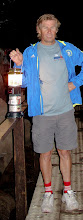
Junior race in Geluveld (Zonnebeke, Belgium) on April 17, 2011. 93km, 15 laps.
This is at the end of lap 10. There are 15 in the break which is a bit strung out at this point, then several followers at 44 and 49s and the pack at 55s.
In other news, Alberto Contador won the time trial in Castilla y Leon. The Australian Richie Porte followed at 1 second. Xavier Tondo remains the leader with Contador in 23rd place at 2:37. Watched the China Grand Prix in Formula 1 this morning. Later today, the London Marathon, the Amstel Gold Race and then on Monday, the Boston Marathon. Wow!
Stay tuned!
Showing posts with label bike racing. Show all posts
Showing posts with label bike racing. Show all posts
Saturday, April 16, 2011


First race, Geluveld
 |
| Getting ready |
The race course was triangular and it had a 1km climb that I judged at 3-4% max. It did not seem to slow people down very much and the average speed was high at 25+ mph.
 |
| Alex is ready to go |
The US National Team was there too and all but one raced (one guy from Colorado was ill and did not start). Matt Lipscomb had the best result as he was in the winning break and able to catch several primes and a second place finish to boot.
 |
| US juniors before the start |
 |
| Attention: bike race |
 |
| Results |
 |
| After the race |
Race day morning
 |
| Bike races |
I woke up at 8 after staying up late last night doing some work and then attending to Addison who was coughing hard. Today started out nice with a temperature of 7C, some sun and predicted high temperatures of 18-19C. This morning we witnessed something typically Belgian: a finch competition.
The road was blocked so people could set up their cages. It is amazing how easy it is to block a public road in Belgium.
 |
| Detour: local traffic and finch people only |
Here are some shots of the bird people in the heat of battle:

And a close-up.
 |
| Counting bird songs |
Some other miscellaneous pictures:
 |
| In the yard: drying race clothing |
 |
| Race schedule for the Canadian U23 team |
Monday, February 28, 2011
Don't cry for me
To say that the Belgian cycling world is disappointed with Opening Weekend is an understatement. "We wait and look out for more and better," read one headline. Another proclaimed, "Crying for the Belgians ? Yes, that is possible."
Belgian Champion Stijn Devolder was even more blunt, saying he was disgusted with Opening Weekend. "It is a weekend to quickly forget." he added. Devolder had problems in both races. He blamed the lack of radios with having to wait 20 km before he could change bikes after his derailleur malfunctioned on Saturday. And on Sunday he crashed on the Oude Kwaremont. Tom Boonen also blamed the absence of radios for bad results. That and plenty of "fresh cowboys in the peloton."
Not a bad weekend for Ivan Basso apparently. The Italian went on to win the GP of Lugano in neighboring Switzerland.
Cadel Evans, meanwhile is taking it easy. The Australian will start his season on Thursday in Fruili, Italy. Evans is aiming for the Tour and he plans to only race 30 or so times before that event. "He could become the oldest winner since Henri Pelissier in 1923," said his manager. That is if he wins! Evans will be 34 by the time the Tour comes along, the same age as Pelissier.
It was pretty cold, but sunny in Northern California. On Saturday I went on a 28 mile bike ride, but yesterday I opted for some indoor training on the treadmill. I have lost some weight since the holiday and that appears to have helped my performance. I managed 325W on my 20 minute test recently and yesterday I ran 8.35 miles on the treadmill in one hour (including warmup). That means I ran over 8.5 for most of the hour.
Sunday, February 27, 2011
Getting your goat
The second race of opening weekend saw a further upset. None other than an Australian by the name of Christopher Sutton won the 67th edition of Kuurne Brussel Kuurne. American expatriate Tyler Farrar was fourth. Tom Boonen tried twice to get some action going, including a break 4km from the finish, but in the end he got caught and it was all over.
Flecha showed his determination in going with Tommeke early on, but his effort too was not good enough. Last year's winner, Bobby Traksel ended up in the (un)lucky thirteenth spot. This is just one of the many upsets we have seen so far this spring. From goats to road pirates, to absent favorites and lack of earphones, the pre-season has been anything but normal.

Speaking of goats disrupting bike races, I just read a herd of goats ran onto Northbound I-5 last night, forcing an hour long highway closure. No, there were no bikers involved, and as you might imagine in the land of oversized pickups and SUV's the goats did not escape unharmed either. About two dozen animals were struck and killed.
This is not the only way America is starting to look like a middle earth empire. According to recent reports on NPR, the income inequality in this country now exceeds anything we find in the First World, by an huge margin. It is also growing at an amazingly fast pace and if we keep this up, pretty soon the situation will not look all that different from that of some countries that have been much in the news recently.
America also exceeds its peers in two other attributes that featured prominently in recent turmoil. One is food insecurity, where 16% of the population said there have been times in the past 12 months when they did not have enough money to buy food. (I agree that this may sound hard to believe in a country where 60% of the population is overweight or obese, but everything is relative of course.)
The other attribute is the prison population per 100,000, which stands at 743, a number that is almost double that of our nearest wealthy competitor.
Finally there is the issue of net worth. America's net worth now stands at about $182,000 per person, according to the WSJ, although they admit the number is pulled up significantly by a small group of very wealthy individuals. A more realistic and much more bleak report says that half the American population has zero net worth.
 |
| Christopher who? |
Flecha showed his determination in going with Tommeke early on, but his effort too was not good enough. Last year's winner, Bobby Traksel ended up in the (un)lucky thirteenth spot. This is just one of the many upsets we have seen so far this spring. From goats to road pirates, to absent favorites and lack of earphones, the pre-season has been anything but normal.
Speaking of goats disrupting bike races, I just read a herd of goats ran onto Northbound I-5 last night, forcing an hour long highway closure. No, there were no bikers involved, and as you might imagine in the land of oversized pickups and SUV's the goats did not escape unharmed either. About two dozen animals were struck and killed.
This is not the only way America is starting to look like a middle earth empire. According to recent reports on NPR, the income inequality in this country now exceeds anything we find in the First World, by an huge margin. It is also growing at an amazingly fast pace and if we keep this up, pretty soon the situation will not look all that different from that of some countries that have been much in the news recently.
America also exceeds its peers in two other attributes that featured prominently in recent turmoil. One is food insecurity, where 16% of the population said there have been times in the past 12 months when they did not have enough money to buy food. (I agree that this may sound hard to believe in a country where 60% of the population is overweight or obese, but everything is relative of course.)
The other attribute is the prison population per 100,000, which stands at 743, a number that is almost double that of our nearest wealthy competitor.
Finally there is the issue of net worth. America's net worth now stands at about $182,000 per person, according to the WSJ, although they admit the number is pulled up significantly by a small group of very wealthy individuals. A more realistic and much more bleak report says that half the American population has zero net worth.
If you believe what you read in the popular press you may think these recent revolts were led by people who yearn for freedom and now that they have FaceBook they are empowered to find it. But if you are the more cynical type you might observe that high unemployment, high food prices, and income inequality are rampant in these locales.
Thursday, November 4, 2010
A season in Belgium: are you ready?

Race entries in Belgium are EUR3 plus a refundable EUR5 and prizes often go 20 deep. If you manage to place you will easily get your money back. Many American juniors who go to Europe in summer are able to race at least one event where they come out ahead. But that is a far cry from making a living, or even paying for the other race-related expenses. You can save money by riding to the venue as most towns are within riding distance. That will save gas money but you still need to eat and pay for your stays. Bringing home EUR12 may sound impressive but it isn't going to pay for the day, let alone a three month stay.
If you really want to make ends meet simply by racing, you need to join a local club. Not only will the club pick up most of your expenses, and often pay for bike maintenance as well, joining a club is the only way to enter the more lucrative interclub events. Joining a club and getting a spot on their team is only realistic if you have a respectable race resume so it is typically not something first time visitors can do. Interclub races have bigger pots and they often have prizes for sprints, king of the mountain competitions and the team as a whole. For a good team that can quickly add up to a respectable sum.
Another way to make a living is to sell your races. Although you can argue that selling races defeats the whole purpose of going to Europe, it is a common practice among expatriates. It is something you can't really plan for and it is only an option for riders who are in a winning break and are known to be good sprinters. They can often sell their spot for much more than the winning prize money.
Foreigners also survive by taking on odd jobs such as bike mechanic, soigneur or waiter but this is something that cannot be legally done without the appropriate visa and permits. Although the government is cracking down on the practice, there is still a lot of under-the-table work in Belgium.
Apart from fitness and finances, the other key issue is separation. There is no doubt that cell phones and the internet have made things easier, but many people still have a hard time being away from family and friends for an extended period of time. Many experience culture shock, and go through several phases of adjustment, often without their knowledge. Symptoms of the honeymoon phase are clearly evident in facebook postings from nieuwelingen attending European camp or juniors racing for the National Team. Many of these kids are simply in love with Belgium and all things Belgian. Even the rain and the wind have a romantic charm to them. For someone like me, who was born and lived in Belgium and wanted nothing more than to escape the miserable weather and trade it in for California sunshine this is a bizarre thing to witness.
Culture shock can cause many other problems, but the one most often seen is excessive racing and overreaching. More than half the U23 racers I met who were staying at a popular cycling housing outfit last summer were suffering from overreaching. Many were exhausted and burned out and quite a few admitted that they were overdoing it. The resident coach told me this happens every year and despite his best efforts and frequent admonitions people repeatedly ride themselves into the ground during the season.
One way to prevent overreaching is to take some time off to go sightseeing, or partake in other activities such as kermesses, the beach, and one of the many festivals.
Subscribe to:
Posts (Atom)