Showing posts with label juniors. Show all posts

Monday, April 18, 2011

Tongeren

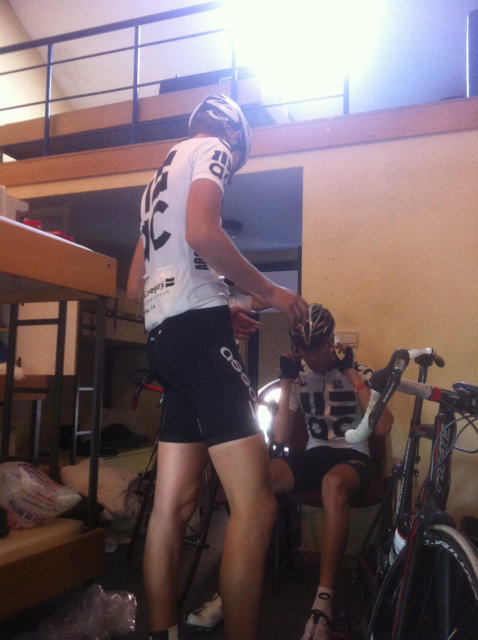
I took the guys to Tongeren this morning. Ann-Kathrin, our former au-pair from Germany came over from Düsseldorf to pick up Alistair and Erik at the airport and we all met up in Tongeren for lunch at the Youth Hostel. The boys settled in, Erik built his bike and they promptly went for a ride while Ann-Kathrin and I went exploring in the city. Here are some shots:

In the lobby of het Begeinhof

First lunch at the youth hostel.

First ride

Erik in his new outfit

Return from the first ride

Ann-Kathrin in the cathedral


Tuesday, December 7, 2010

Racing in Belgium in 2011

I have options available for juniors (racing age 17-18) to race in Belgium next season (2011). These include hard to get team slots for stage races. Please contact me for more information. Thanks!

Wednesday, November 3, 2010

Belgium: bike clubs

Belgium has hundreds of bike clubs that are members of the Wielerbond Vlaanderen. You can find a complete list on the website. You will notice that clubs are listed as clubs met renners (clubs with racers), wielertoeristenclubs (cycling tourist clubs) and organizerende clubs (clubs that organize events). Check one of these options and click the zoek (search) button to see a list of clubs in that category. The listing shows the club's location and the contact information.

You can select alle provincies (all provinces) or choose your favorite province. You can also sort clubs (sortering) op postnummer (by zip code), op gemeente (by town), or op stamnummer (literally by tribe number).

Flemish provinces are West-Vlaanderen, by the North Sea and around Brugge, in the upper left corner; Oost-Vlaanderen, home of de Vlaamse Ardennen (Flemish Ardennes), Oudenaarde and Gent, to the east; Antwerpen, the Northern most province around the port city of Antwerpen. Limburg in the upper right hand corner around Hasselt, and Vlaams Brabant, the Flemish part of the central province around Brussel.

Zip codes are four digit codes that start with 8 in West Vlaanderen, 9 in Oost Vlaanderen, 2 in Antwerpen, 3 in Limburg, and 1 in Brabant. The provincial capital has three zeros so Brugge is 8000, Gent is 9000, Antwerpen is 2000, Hasselt is 3000 and Brussel is 1000.

Also note that a club with racers has separate teams for every age group they serve. Most clubs that support youth racing do so from miniemen up to the junioren level. They will usually have an aspiranten team, a nieuwelingen team and a junioren team. Some of the best nieuwelingen and junioren  team clubs do not have a beloften (U23) team and so riders are forced to switch when they reach 19. In most races beloften race with Elites z/c (amateur riders).

It is possible to join a team for a race or a set of races if you contact them beforehand and they have slots available. Usually a team will have many more riders than they can field in an interclub event and internal competition for these events is fierce. However that does not mean you can't get a slot. Due to age restrictions, younger riders will often have to give up a spot in order to remain eligible for other events. Sometimes riders will give up prime slots in stage races (where they are restricted to just a few events per year) in order to race in other countries with the Belgian national team.

For youths it is generally easiest to join a team for a junioren event. Here is where you often find the optimal conditions in terms of age restrictions, number of available team riders, and number of available events. It is also fairly easy to join a team for a Elite z/c event (i.e. amateurs in the open category). Furthermore, by age 17 most solid riders have enough of a resume to convince team managers that they will live up to expectations. Without a resume that shows at least some racing in Belgium, convincing a manager may be tough to do.

The various cycling houses  have affiliations with local teams and if you show good race results while staying there, you may get a slot for a team-only event. But it is not required that you stay at one of these in order to make a team. Getting yourself noticed during a race and talking to potential managers and riders afterwards is often enough to do the trick. Nearly all big races from the nieuwelingen level on have talent scouts in the crowd. At a nieuwelingen stage race last summer I noticed Omega Pharma Lotto, Rabobank, and RadioShack along the course.

Going on training rides -almost always welcomed- with a team is another good way to become visible. Many teams are attached to a local bike store and hanging out in the store (especially in the back where the mechanics are) will get you connected to the right people pretty quickly. Although nearly everyone speaks English, it is definitely helpful if you learn some words in Flemish. And the best place to learn relevant words is to go on rides with people.

Wednesday, September 29, 2010

A closer look at the calendar

The race calendar can be found under

When you look at the calendar on the website of the Wielerbond Vlaanderen you will notice that races are listed by date in a particular format. It is worth learning to decipher that format.

The races are listed by date. Unlike the US, date format in Europe is day/month/year.
Within dates the races are listed alphabetically by title (eg. RONDE VAN VLAANDEREN). When there is no official title, the name of the city or town where the race is being held is listed. So for instance you may find that on August 1, 2010 the following races took place:
BALEN (STEEG)
BIERBEEK -BREMT
BRASSCHAAT (BETHANIE)
BUGGENHOUT (P.K)
DEINZE
DENDERWINDEKE
...(etc. etc.)
The above titles are all names of municipalities (city, town or village). In paratheses you find additional information (town subdivision, parish, etc.) or special type labels (P.K. Provinciaal kampioenschap -provincial championship, B.K. Belgian championship, etc.).

Next you see the labels "OO" or "GO." OO means Open Omloop, or open course, whereas GO means Gesloten Omloop or closed course.
OO races are not completely closed to traffic. Rather, a rolling closure is used. What that means is that dropped riders will most likely be pulled by the police when the gap grows to greater than 3 minutes. In a GO race, all competitors can usually stay in the race to the end.

Underneath you find a three letter UCI code (eg. 1.14.3 for BALEN). The code works as follows:
x.y.z, where x designates whether the race is a one day race (1) or a multi-day stage race (2). (The race in BALEN is a one day event as evidenced by the 1.y.z)

y is the category. Nieuwelingen are 17, women elites 15, juniores 14, Elites without contract and U23 are 12. Other designations are common and may refer to category, eg. GENTL, which means gentlemen, or type, eg. MB means mountain bike, etc. UCI designations such as MJ meaning men junior and ME, or men elite are also commonly used.

z is the competitive level. 3 means an individual (not a team) race. 1 is the highest level (except for things like TOP which means top competition, or HC, which means hors categorie or out of category).

So the race in BALEN is a 1.14.3 or an individual race for juniors. Many such races are held at the time of the village festival, known as a "kermis" in Dutch or "kermesse" in French. Most US riders call these races kermesses but the kermesse is the festival. The race is a kermiskoers or course de kermesse. Not all x.y.3s are kermiskoersen.

Note that as a rule, there will only be one race, for one category at any one location on a given day. BALEN or any other city may well have a nieuwelingen race (1.17.3), a juniors race (1.14.3) and even a pro race for its "kermis" but these events will be held on different days.

The race in DENDERWINDEKE is a 1.17 TOP or a race for nieuwelingen at the TOP competition level. The actual UCI code for that race is NAT or National Calendar. That race is not open to individuals. Only members of a team can compete.

In general, visitors can enter any race that has a x.y.3 designation, provided they are members of the "y" category. So nieuwelingen with a UCI license, a permission letter and a kalenderkaart can enter any 1.17.3 race.

There is no need to call in advance to race. All you do is show up and pay the EUR3 (plus a refundable EUR5 for the race number) and you are set.

To find out where and when you need to do that, you click on the race title or the ">" mark and find out the "technische gegevens" or technical info.
Let's check out the Technical info for the BALEN race.

It reads:
84,5 km-447 EUR - I: Feesttent, Steegsebaan, 2490 Balen -U: 13:30/14:45/15:00 - Contact: Andre Van de Weyer, St. Rochusstraat 26, 2490 Balen (Tel: 0473 97 26 96) -Extra info: 13 ronden van 6,500 km.

What that means is:
84.5 km total distance (note that Belgians use a comma instead of a period)
447 EUR that is the total prize money
I means inschrijving or registration. It is held at the Feesttent or festival tent and the tent is located on the Steegsebaan in Balen. 2490 is the zip code.

Although the street address may sound confusing, remember that races are almost always held in the center of town where everyone can watch them. The Feesttent in Balen will be very easy to find. It is meant to be found and is used for other kermis events such as dinners, dancing, and maybe even a performance. Everyone in Balen will know where the Feesttent is.

Registration will open at 13:30, staging will be at 14:45 and the race will start at 15:00 or 3PM. Note the use of a 24 hr clock (aka military time in the US).

The contact person is listed with their address and phone number. The number is a cell phone (starting with a zero plus a three digit area code that starts with a 4). You can call Andre -who probably speaks fluent English, but there is almost never any need to. If you just show up with your paperwork and your money, you will be allowed to race. You won't have to fill out any complex forms and you don't even need to bring your parents. Any 15 yr old can go into the bar (yes registration is usually in a bar or a feesttent, which is a temporary bar) and nobody will be upset when the young racers enter that bar.

The extra info says the race will be 13 laps (ronde) of 6.5 kms each.

After the race, you are asked to return your number. You will also get your prize money -often 20 deep- and if you happen to finish in the top three, you are kindly asked to stick around for the festivities. The latter is not to be taken lightly and if you bail, you will be blacklisted.

Results will be on the web within hours after the race. Furthermore, they will likely be correct too.


Tuesday, June 29, 2010

Small country

We just got back from Junior National Championships in Bend, Oregon. It is events like these that make you realize that when it comes to cycling, the US is a very small country. I believe a grand total of some 750 riders showed up for the event. That covers all age groups 10-23 yrs of age, both genders, and quite possibly a number of Cat 1's as well since the Elite Criterium championships were held concurrently. To say nothing of the Paralympic Championships.

In essence, the event is like a provincial championship in Belgium. For those of you unfamiliar with Belgium, it is a small country in Northern Europe, about the size of the State of Maryland, with about 10.5 million inhabitants. It has 9 provinces. Which means there are nine provincial championships each year.

Nationals, as it is called, is the most competition one can get in the US. As National Team Coach Ben Sharp pointed out in his presentation about European Cycling, one can often find more junior men (17-18s) racing within 50 miles of another on any one given day in Belgium.

That does not mean Americans don't have talent. Although we have a small sample, it is clearly an enriched sample. It is also remarkable how many have parents who are first generation citizens, dual citizens, or with otherwise very strong ties to Europe or Latin America.

There is good talent but there are also serious holes in the competition. When someone wins consistently and with a large gap, like Craddock did in the junior men category, you can be sure it is a sign of strength. However, the same cannot be said about many other medalists and runner-ups. Did they end up first, second or third because they are first, second or third, or are they there because the real first, second or third is not?

Clearly a lot of potentially promising American juniors do not ride bikes. They are running track, cross country skiing, or maybe even playing baseball. While we have an impressive line-up of pro riders (yes there are good American riders besides Lance), a country this size should completely dominate the sport of cycling. With 300 million inhabitants, America has a larger pool to choose from than Europe does (not all European countries are fond of cycling).

Yes we have come a long way, but there is still a long way to go.