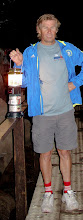
Yesterday I found out that I passed my power based training exam. I heard from the cycling manager that I had been power licensed for some time, but nobody had notified me and he could not tell me exactly what happened or why. In any case I am happy to say that I passed the test and if you have any questions regarding training with power, feel free to contact me.
I also want to let everyone know that I will be taking a break from this blog for a while. I am not sure how long yet, but 1 to 3 weeks seems in order. During that time I want to think more about the future of the blog and what direction I want to take in. I want to thank all my readers for sticking with me, and for all the comments I received -although most were not posted here, but arrived on facebook, or in emails, or in conversations with friends.
This blog has been undergoing a steady metamorphosis. It started out as a way for me to keep track of my workouts and write an occasional piece about my racing and training experience. Then I added more comments about training in general, but last year after the summer after a brief recess, I took a different tack and began writing about Belgium and bike racing in Belgium. That dramatically increased my readership but it also brought on a lot of extra work. Although I was able to promote the blog with some measure of success, the increased workload is catching up to me.
Look here for information on cyclist housing in Belgium.
Look here for information on traveling to Belgium to race.
Look here for information on what you need to race your bike in Belgium.
Look here for information on how to read the race calendar.
And that is why I have to say, later. Hang in there and check back in a few weeks.
Showing posts with label cycling. Show all posts
Showing posts with label cycling. Show all posts
Thursday, March 3, 2011


Thursday, February 24, 2011
Recovery drink
The issue of recovery drinks came up again yesterday after someone posted an article and ad from Erdinger Alcoholfrei touting its benefits as a recovery drink. Although Erdinger is a beer and the title of the report read Athletes Replacing Sports Drinks with Beer, I need to point out that Alcoholfrei means free of alcohol, so the beer that is being sold here is not a real beer. Certainly not real in the Belgian sense of beer. It is simply a brewed concoction that had the alcohol removed.
The article was news to cyclists but triathletes have long known about this brand through none other than Faris al-Sultan, the former ironman world champion.

I am not sure why people are so convinced that they need a recovery drink, but in America at least, the consensus seems to be that one cannot perform well without them. It is like stretching prior to running, or massage after an ironman. People simply assume that one cannot recover well or perform well without those rituals and potions. As I have pointed out many times before I do not lend credence to these beliefs. Furthermore I am living proof that one can improve -and improve quite significantly I might add- without all this stuff.
The issue of recovery drinks got a big boost last year when none other than Fabian Cancellara was seen gulping down a protein shake after winning the Tour of Flanders in a rather decisive way. His action had a profound impact on the normally cynical Europeans, and before anyone thought of the infamous cancellara-motor, the protein shake was widely mentioned and credited with magical powers.
Years ago when I ran Ironman Switzerland, which was not one of my best performances by the way although I had the shortest T1 there, I was treated to Erdinger after the race. It tasted really good and due to its low (or absent) alcohol content I was able to drink quite a bit of it without getting drunk. I must admit though that as soon as my biggest thirst was over, I did top it off with a good bona fide beer, before jumping into the hot tubs that were provided at the finish line by one of the race sponsors.
Beer is a very popular recovery drink for many master athletes and when it is available it appears most prefer it to sodas or other drinks. Nonetheless, these people would not dare call it a recovery drink (other than jokingly) or even admit that they consumed it after the race or ride.
True recovery drinks are protein drinks or protein shakes. In essence they are usually nothing more than chocolate milk, although some like chocolate milk shakes (i.e. with ice cream). The commercial versions sold by PowerBar and other companies are essentially chocolate milk with some added salts and vitamins.
The rationale behind recovery drinks -apart from having more stuff to sell- seems to be the finding that muscle is more eager to take up protein (read amino acids) in the first twenty or thirty minutes after hard exercise. The finding by itself is not surprising and one would expect muscle recovery to involve enhanced amino acid uptake. The real question of course is whether supplying oral protein immediately after exercise will actually lead to better recovery.
I.e. it may well be true that muscle is more receptive to circulating amino acids for a limited time immediately after exercise. But that does not necessarily mean that supplying oral protein will make a difference. The first issue to consider is whether we can get the amino acids that are being supplied by eating or drinking protein to the muscle in time. Even if you gulp down a protein drink immediately after the race, it will take quite a while for your digestive system to process it. Unlike carbohydrates (sugars) protein digestion is a rather slow process. Add to that the fact that in many individuals the digestive tract is essentially shut down, and you can see that we are faced with more than a theoretical hurdle.
But there is no reason to worry. There is ample time for muscle recovery to take place. Even for those involved in multi-day stage races, the overnight hours are all it takes. And unless activity is at a very high level from day to the next, a few hours recovery is all it takes. Without the need for special food items. Such is the lesson we learn from RAAM. As a matter of fact, the more normal your diet, the better you will do.
It is really only at the end of 2-3 week high intensity stage races that people tend to fall behind and end up in a catabolic state.
And one last thought. Drinking or eating protein during the race is definitely unnecessary. There is no way muscle can build protein during an event so all the protein you ingest gets burned as either carbohydrate or fat (the explanation needs a bit of biochemistry here but suffice it to say that some amino acids get burned as carbs, while others go down the fat pathway). All the protein ingested during an event -to the extent that you can digest it- gets burned as fuel.
Many people however, do like to eat some protein in a long event such as ironman. Although the protein per se won't help muscle recovery, there is also no reason to avoid protein either- as some would advise. The extra nitrogen load is negligible and unless you have advanced kidney disease -in which case you probably would not compete- there is nothing to worry about.
The bottom line: don't spend your money on fancy recovery concoctions. Have a beer or drink some chocolate milk. And don't worry about eating a sandwich during Ironman. You will feel better and hence you will do better too!
The article was news to cyclists but triathletes have long known about this brand through none other than Faris al-Sultan, the former ironman world champion.
 |
| Erdinger sponsors triathlon events |
I am not sure why people are so convinced that they need a recovery drink, but in America at least, the consensus seems to be that one cannot perform well without them. It is like stretching prior to running, or massage after an ironman. People simply assume that one cannot recover well or perform well without those rituals and potions. As I have pointed out many times before I do not lend credence to these beliefs. Furthermore I am living proof that one can improve -and improve quite significantly I might add- without all this stuff.
The issue of recovery drinks got a big boost last year when none other than Fabian Cancellara was seen gulping down a protein shake after winning the Tour of Flanders in a rather decisive way. His action had a profound impact on the normally cynical Europeans, and before anyone thought of the infamous cancellara-motor, the protein shake was widely mentioned and credited with magical powers.
 |
| Fabian on the kapelmuur |
Years ago when I ran Ironman Switzerland, which was not one of my best performances by the way although I had the shortest T1 there, I was treated to Erdinger after the race. It tasted really good and due to its low (or absent) alcohol content I was able to drink quite a bit of it without getting drunk. I must admit though that as soon as my biggest thirst was over, I did top it off with a good bona fide beer, before jumping into the hot tubs that were provided at the finish line by one of the race sponsors.
Beer is a very popular recovery drink for many master athletes and when it is available it appears most prefer it to sodas or other drinks. Nonetheless, these people would not dare call it a recovery drink (other than jokingly) or even admit that they consumed it after the race or ride.
True recovery drinks are protein drinks or protein shakes. In essence they are usually nothing more than chocolate milk, although some like chocolate milk shakes (i.e. with ice cream). The commercial versions sold by PowerBar and other companies are essentially chocolate milk with some added salts and vitamins.
The rationale behind recovery drinks -apart from having more stuff to sell- seems to be the finding that muscle is more eager to take up protein (read amino acids) in the first twenty or thirty minutes after hard exercise. The finding by itself is not surprising and one would expect muscle recovery to involve enhanced amino acid uptake. The real question of course is whether supplying oral protein immediately after exercise will actually lead to better recovery.
I.e. it may well be true that muscle is more receptive to circulating amino acids for a limited time immediately after exercise. But that does not necessarily mean that supplying oral protein will make a difference. The first issue to consider is whether we can get the amino acids that are being supplied by eating or drinking protein to the muscle in time. Even if you gulp down a protein drink immediately after the race, it will take quite a while for your digestive system to process it. Unlike carbohydrates (sugars) protein digestion is a rather slow process. Add to that the fact that in many individuals the digestive tract is essentially shut down, and you can see that we are faced with more than a theoretical hurdle.
But there is no reason to worry. There is ample time for muscle recovery to take place. Even for those involved in multi-day stage races, the overnight hours are all it takes. And unless activity is at a very high level from day to the next, a few hours recovery is all it takes. Without the need for special food items. Such is the lesson we learn from RAAM. As a matter of fact, the more normal your diet, the better you will do.
It is really only at the end of 2-3 week high intensity stage races that people tend to fall behind and end up in a catabolic state.
And one last thought. Drinking or eating protein during the race is definitely unnecessary. There is no way muscle can build protein during an event so all the protein you ingest gets burned as either carbohydrate or fat (the explanation needs a bit of biochemistry here but suffice it to say that some amino acids get burned as carbs, while others go down the fat pathway). All the protein ingested during an event -to the extent that you can digest it- gets burned as fuel.
Many people however, do like to eat some protein in a long event such as ironman. Although the protein per se won't help muscle recovery, there is also no reason to avoid protein either- as some would advise. The extra nitrogen load is negligible and unless you have advanced kidney disease -in which case you probably would not compete- there is nothing to worry about.
The bottom line: don't spend your money on fancy recovery concoctions. Have a beer or drink some chocolate milk. And don't worry about eating a sandwich during Ironman. You will feel better and hence you will do better too!
Saturday, January 15, 2011
Core values
This week I received a paper copy of my November 19 deposition. The weighty volume is a transcript of my day-long testimony in a lawsuit that revolves around a patent issue that I know nothing about. One of the lawyers told me afterwards it was a big waste of everyone's time. Not to mention a waste of all the trees that were cut down to produce this hefty volume in thousandfold.
Now I am supposed to spend another day reading through all of it to make sure my testimony is correct. Not once did we talk about the actual complaint because, as I mentioned before, I knew nothing about the matter. My compensation for all this trouble ? $35 to pay for gas and parking.
Today felt like summer. The temperature was 20C/68F and the sun was out all day. We went on a long ride in Marin county, climbing Mt Tamalpais (affectionately known as Mt Tam) twice. The views coming down into Stinson beach were spectacular. Here is a picture (taken on New Year's eve in the late afternoon) of those views. Only today the sky was bright blue and it was sunny and warm.
Meanwhile, most of the country is busy snow shoveling, a cardio workout that is not only very strenuous but also rather dangerous and injury prone. But if you are not snow shoveling, you are probably riding your trainer for hours on end, an activity that is both mind numbing and unpleasantly sweaty. Or maybe you go to gym for your core workouts or to do some yoga and stretching.
Well, I have good news for you. Now there is the ballbike. (You may want to set your computer to mute before you open this link.) In any case, after you do so, it behooves you to take a look at this marvel, that elegantly combines core exercises with pedaling. If you are one of those people who believes it is important to strengthen your core, this contraption may well be a godsend for you.
According to the website, the marvelous invention is sure to produce that six-pack that all cyclists secretly long for- just in time for summer.
Although it may be exciting to try the ballbike at a trade-show, I for one, would stick with a conventional trainer. Or better still, rollers. Although the sensual wiggling motions of the ballbikers may evoke images of a stronger core, I can assure you that riding rollers will be of much greater benefit to both your fitness and your bike handling skills. As for core, leave that to the dancers and gymnasts.
 |
| Lots of paper |
Today felt like summer. The temperature was 20C/68F and the sun was out all day. We went on a long ride in Marin county, climbing Mt Tamalpais (affectionately known as Mt Tam) twice. The views coming down into Stinson beach were spectacular. Here is a picture (taken on New Year's eve in the late afternoon) of those views. Only today the sky was bright blue and it was sunny and warm.
 |
| Road to Stinson Beach |
Well, I have good news for you. Now there is the ballbike. (You may want to set your computer to mute before you open this link.) In any case, after you do so, it behooves you to take a look at this marvel, that elegantly combines core exercises with pedaling. If you are one of those people who believes it is important to strengthen your core, this contraption may well be a godsend for you.
 |
| Forget the Lemond Revolution, here comes the ballbike |
 |
| Cyclist six pack |
Although it may be exciting to try the ballbike at a trade-show, I for one, would stick with a conventional trainer. Or better still, rollers. Although the sensual wiggling motions of the ballbikers may evoke images of a stronger core, I can assure you that riding rollers will be of much greater benefit to both your fitness and your bike handling skills. As for core, leave that to the dancers and gymnasts.
 |
| Core Strength |
Sunday, January 2, 2011
Weight loss
I talk about weight a lot because weight is key to success in aerobic events such as running, cycling and cross country skiing. Many master's athletes are overweight or borderline so. For these folks losing weight will do more than anything else to improve their performance.

Today I have another reason for focusing on weight and that is the New Year. Weight loss is probably the number one New Year's resolution in the country and it is also the one that is most likely to fail. There are a number of important (and rather counter-intuitive) reasons why that is so.
First let's talk about genetics. There is no doubt that genetics plays a big role in one's tendency to gain weight and to become overweight or obese. Yet genetics is not the whole story and genetics alone cannot explain the huge wave of obesity that we are currently witnessing. Unless you are one of those rare individuals with a tendency for morbid obesity -and there are very few of you- you should be able to maintain normal weight regardless of your genetic background.
Genetics is often nothing more than an excuse for overindulgence. If you are the type of person who feels like you should at all times be comfortable and enjoy life; If you always indulge yourself or feel like "you deserve it," chances are you are overweight.
The main reason why people fail in weight loss is because they focus on diet. Diet is the last thing you should worry about. If you focus on diet you are setting yourself up for failure. Not only will you gain your weight back quickly, you are very likely to add on some extra each time around and enter into a vicious circle of dieting and weight gain.
Losing weight is very easy. As soon as you eat less you will lose weight. That will happen regardless of what diet you adhere too. Any and all diets that supply less calories than you burn will cause you to lose weight. That is why the diet itself is the least of your worries. Looking for a magic diet is a waste of time.
The truly hard part is not losing the weight, it keeping the weight off. And that won't happen unless you are prepared to change the way you live. Contrary to popular belief you do not need to live like a monk to keep your weight off. Many monks are overweight too.
It is quite possible to live a good life without overindulging. As a matter of fact, restraint is often better and leads to better outcomes than it appears. Walking in the rain instead of driving may appear less fun, but once you get going you will surely enjoy it more. Leaving that extra cake on the tray is not going to make you any less happy but it may save you an upset stomach or a bloated feeling afterwards. Taking the stairs instead of waiting for the elevator may get you to your destination sooner. Foregoing immediate pleasure often leads to more and better pleasures later.

If you are serious about your New Year's resolution to lose weight, then focus on how you will change your lifestyle first. Once you do that, eating less should be easy.
Today I have another reason for focusing on weight and that is the New Year. Weight loss is probably the number one New Year's resolution in the country and it is also the one that is most likely to fail. There are a number of important (and rather counter-intuitive) reasons why that is so.
 |
| An oversized bottom bracket |
First let's talk about genetics. There is no doubt that genetics plays a big role in one's tendency to gain weight and to become overweight or obese. Yet genetics is not the whole story and genetics alone cannot explain the huge wave of obesity that we are currently witnessing. Unless you are one of those rare individuals with a tendency for morbid obesity -and there are very few of you- you should be able to maintain normal weight regardless of your genetic background.
Genetics is often nothing more than an excuse for overindulgence. If you are the type of person who feels like you should at all times be comfortable and enjoy life; If you always indulge yourself or feel like "you deserve it," chances are you are overweight.
The main reason why people fail in weight loss is because they focus on diet. Diet is the last thing you should worry about. If you focus on diet you are setting yourself up for failure. Not only will you gain your weight back quickly, you are very likely to add on some extra each time around and enter into a vicious circle of dieting and weight gain.
 |
| Vicious circles |
Losing weight is very easy. As soon as you eat less you will lose weight. That will happen regardless of what diet you adhere too. Any and all diets that supply less calories than you burn will cause you to lose weight. That is why the diet itself is the least of your worries. Looking for a magic diet is a waste of time.
The truly hard part is not losing the weight, it keeping the weight off. And that won't happen unless you are prepared to change the way you live. Contrary to popular belief you do not need to live like a monk to keep your weight off. Many monks are overweight too.
 |
| Gluttony |
It is quite possible to live a good life without overindulging. As a matter of fact, restraint is often better and leads to better outcomes than it appears. Walking in the rain instead of driving may appear less fun, but once you get going you will surely enjoy it more. Leaving that extra cake on the tray is not going to make you any less happy but it may save you an upset stomach or a bloated feeling afterwards. Taking the stairs instead of waiting for the elevator may get you to your destination sooner. Foregoing immediate pleasure often leads to more and better pleasures later.
If you are serious about your New Year's resolution to lose weight, then focus on how you will change your lifestyle first. Once you do that, eating less should be easy.
Friday, December 24, 2010
Last minute gift ideas
Here are some last minute ideas for your Christmas shopping list. Don't worry you are not alone in needing to find that last minute present.
Retailers all over the country are bracing for a second black Friday onslaught. What better way to spend your Christmas Eve than to do your patriotic duty and go shopping to rescue the economy?
Here is my list:
For the athlete who has it all (including a power meter) there is sweat analysis, courtesy of Carmichael systems. Move over lactate, VO2 max and threshold power, in come the bodily fluids. I am sure they will throw in a free urine analysis to check for doping if you ask politely enough.
For the athletes who like to impress their prospective girl/boyfriends or the neighbors with their awesome power output, there are a number of power meters, including these beauties.

For those having trouble finding their way out of a paper bag there is an endless list of GPS toys. And for the bikeless runners who might get lost and fall prey to mountain lions, rattlesnakes and killer bees, there are these. Highly recommended for your baby boomer athlete!

Here is a cure for those in the hood suffering from wheelset envy. If the set exceeds your disposable income, you can always go back to your childhood days and attach playing cards to your spokes.

Other neighborhoods like to show off their lights instead. Here are some great ideas that won't require a second mortgage but are sure to dazzle Wusteria lane.

For those unfortunate enough to be snowed in, there is the revolution trainer from good old Greg. This one will get you ready for the Tourmalet once the white stuff turns to slush.
If your bikes tend to get stolen you can always use these. They are guaranteed to work better than a Kryptonite lock. Not to mention the visual deterrent factor. Take that bike thief-wanna bees!

If you really run out of ideas there is always a box of protein bars or some magic powder at the grocery store. This stuff will surely propel your would-be athlete to the top of the podium.
 For those down to earth, nothing works better than a pair of warm socks, or mittens.

As for me, I will be indulging in a Belgian Christmas brew while waiting for my New Year's gifts.

Happy Holidays.
Retailers all over the country are bracing for a second black Friday onslaught. What better way to spend your Christmas Eve than to do your patriotic duty and go shopping to rescue the economy?
Here is my list:
For the athlete who has it all (including a power meter) there is sweat analysis, courtesy of Carmichael systems. Move over lactate, VO2 max and threshold power, in come the bodily fluids. I am sure they will throw in a free urine analysis to check for doping if you ask politely enough.
For the athletes who like to impress their prospective girl/boyfriends or the neighbors with their awesome power output, there are a number of power meters, including these beauties.
For those having trouble finding their way out of a paper bag there is an endless list of GPS toys. And for the bikeless runners who might get lost and fall prey to mountain lions, rattlesnakes and killer bees, there are these. Highly recommended for your baby boomer athlete!
Here is a cure for those in the hood suffering from wheelset envy. If the set exceeds your disposable income, you can always go back to your childhood days and attach playing cards to your spokes.
Other neighborhoods like to show off their lights instead. Here are some great ideas that won't require a second mortgage but are sure to dazzle Wusteria lane.
For those unfortunate enough to be snowed in, there is the revolution trainer from good old Greg. This one will get you ready for the Tourmalet once the white stuff turns to slush.
If your bikes tend to get stolen you can always use these. They are guaranteed to work better than a Kryptonite lock. Not to mention the visual deterrent factor. Take that bike thief-wanna bees!
If you really run out of ideas there is always a box of protein bars or some magic powder at the grocery store. This stuff will surely propel your would-be athlete to the top of the podium.
As for me, I will be indulging in a Belgian Christmas brew while waiting for my New Year's gifts.
Happy Holidays.
Tuesday, November 30, 2010
Why you must race in Belgium if you are serious
In earlier posts I have discussed why Americans are often reluctant to go race in Belgium or let their children race in Belgium. I have attempted to show that most perceived obstacles (expenses, long travel, safety, language, etc.) are not serious impediments and that cycling in Belgium is really a bargain compared to anywhere else in the world. I have laid out the many advantages of racing in Belgium (competition, critical mass, etc.) versus other places.

But there is one key reason why juniors must to go Belgium if they are serious about cycling. Anyone with Olympic aspirations or anyone considering a career in cycling needs to go to Belgium as soon as possible. The reason is very simple: cycling is a European sport and it will be that way for the foreseeable future. Much like aspiring baseball players flock to the US, aspiring cyclists flock to Belgium.
While American cycling has made great strides and continues to do so, it is clear that for anyone who is old enough to involved in it now the future lies in Europe. Perhaps the only exception to this is for women's cycling. Although women's cycling has gained in Europe it is nowhere near as popular as men's cycling and this is the one area where the US is highly competitive.
For all others, junior racing in America can serve only one purpose apart from entertainment: to convince USA Cycling coaches and-or local sponsors that one is good enough to go to Europe. To repeat that bluntly: the only reason why juniors compete in big events in the US is so that they can impress the national coaches and be taken to Europe -i.e. Belgium.
However, if one aspires to be on the National Team selection to go to Restricted Events, one should race in Europe as much as possible. USA Cycling's guidelines for selecting members of the National Team makes it clear that placing in a European event is preferred over a similar or better result in a US race. So why follow a circuitous path of traveling all over the country -which is quite expensive by the way- so as to impress people so they take you to Europe, if you can just go to Europe on your own for a whole lot less money. Why not cut to the chase?
Rest assured that whatever you accomplish in Belgium will be visible, whereas your wonderful performances in the US may easily go unnoticed. You may think that going to Europe and disappearing from the radar screen in the US will be bad for your career, but you could not be more mistaken. When you are in Europe you are on everyone's radar. When you are here on the other hand, you are practically invisible, and certainly invisible to most people who matter in terms of cycling careers. Because all those people are in Europe. And they or their talent scouts are attending junior races (and even nieuwelingen races) over there.
Saturday, November 27, 2010
Wiggins wigs us out
A short interview with Bradley Wiggins regarding the US track team has the US cycling community up in arms. It is of course not the first time that the Brit or his companions have taken swipes at US cycling. Jonathan Vaughters recently ridiculed Armstrong's 2009 Tour de France performance. But the latter went largely unnoticed due to the outrage Americans felt at Contador's behavior. Hence the joy many felt when Contador was caught doping. It only reinforced what they already knew: that Contador was a bad apple who stole Lance's eight Tour.

USA cycling representatives quickly pointed out their world record performances in women's cycling, and took offense at the notion of Taylor Phinney being labeled "pretty good." Never mind that "pretty good" in British English is roughly equivalent to "awesomely spectacular" in American English. For once, even those who know better choose to ignore their cultural awareness and take "pretty good" at face (that is American) value. Over here "pretty good" means "awfully bad."

In any case, let me just play the devil's advocate and be very blunt. Wiggins is not the only one who thinks American cycling is only so-so. It is an opinion that most European cycling fans share, but won't admit too. To say Europeans treat Americans in a circumspect way is an understatement. Ever since WWII, people in Western Europe do not want to say bad things about America or Americans.
Even when Europeans question the sanity of America, as they did with Reagan and his missiles, the charade known as the Monica Lewinsky affair, and the bible-toting, tough talking Bush Jr. and his Iraq debacle, Europeans are loath to criticize the new world.
It is perhaps fair to say that Europeans and the Brits still feel a certain kinship with their former expatriate and colonial brethren. In any case those left behind feel it more apparently than those who left the continent, or whose forefathers left the continent. They can't seem to ever get enough of showing old Europe how smart their decision to leave really was.

Another factor one should not underestimate is financial incentives. Europeans would love it if American cycling became successful. Not only would it greatly expand size of the market for cycling related items, it would add a rich market composed of big spenders. One thing Europeans particularly like about Americans is that Americans have money - and unlike some other rich countries- Americans love spending. That is why everyone is European cycling is prepared to give America a lot of leeway.
USA cycling representatives quickly pointed out their world record performances in women's cycling, and took offense at the notion of Taylor Phinney being labeled "pretty good." Never mind that "pretty good" in British English is roughly equivalent to "awesomely spectacular" in American English. For once, even those who know better choose to ignore their cultural awareness and take "pretty good" at face (that is American) value. Over here "pretty good" means "awfully bad."
In any case, let me just play the devil's advocate and be very blunt. Wiggins is not the only one who thinks American cycling is only so-so. It is an opinion that most European cycling fans share, but won't admit too. To say Europeans treat Americans in a circumspect way is an understatement. Ever since WWII, people in Western Europe do not want to say bad things about America or Americans.
Even when Europeans question the sanity of America, as they did with Reagan and his missiles, the charade known as the Monica Lewinsky affair, and the bible-toting, tough talking Bush Jr. and his Iraq debacle, Europeans are loath to criticize the new world.
It is perhaps fair to say that Europeans and the Brits still feel a certain kinship with their former expatriate and colonial brethren. In any case those left behind feel it more apparently than those who left the continent, or whose forefathers left the continent. They can't seem to ever get enough of showing old Europe how smart their decision to leave really was.
Another factor one should not underestimate is financial incentives. Europeans would love it if American cycling became successful. Not only would it greatly expand size of the market for cycling related items, it would add a rich market composed of big spenders. One thing Europeans particularly like about Americans is that Americans have money - and unlike some other rich countries- Americans love spending. That is why everyone is European cycling is prepared to give America a lot of leeway.
Tuesday, June 29, 2010
Small country
We just got back from Junior National Championships in Bend, Oregon. It is events like these that make you realize that when it comes to cycling, the US is a very small country. I believe a grand total of some 750 riders showed up for the event. That covers all age groups 10-23 yrs of age, both genders, and quite possibly a number of Cat 1's as well since the Elite Criterium championships were held concurrently. To say nothing of the Paralympic Championships.
In essence, the event is like a provincial championship in Belgium. For those of you unfamiliar with Belgium, it is a small country in Northern Europe, about the size of the State of Maryland, with about 10.5 million inhabitants. It has 9 provinces. Which means there are nine provincial championships each year.
Nationals, as it is called, is the most competition one can get in the US. As National Team Coach Ben Sharp pointed out in his presentation about European Cycling, one can often find more junior men (17-18s) racing within 50 miles of another on any one given day in Belgium.
That does not mean Americans don't have talent. Although we have a small sample, it is clearly an enriched sample. It is also remarkable how many have parents who are first generation citizens, dual citizens, or with otherwise very strong ties to Europe or Latin America.
There is good talent but there are also serious holes in the competition. When someone wins consistently and with a large gap, like Craddock did in the junior men category, you can be sure it is a sign of strength. However, the same cannot be said about many other medalists and runner-ups. Did they end up first, second or third because they are first, second or third, or are they there because the real first, second or third is not?
Clearly a lot of potentially promising American juniors do not ride bikes. They are running track, cross country skiing, or maybe even playing baseball. While we have an impressive line-up of pro riders (yes there are good American riders besides Lance), a country this size should completely dominate the sport of cycling. With 300 million inhabitants, America has a larger pool to choose from than Europe does (not all European countries are fond of cycling).
Yes we have come a long way, but there is still a long way to go.
Friday, May 21, 2010
Doping
Once again the sport of cycling is being rocked by another doping scandal. Although the Floyd Landis' accusations made front page news in the mainstream US media yesterday, it seems most of the amateur cycling community prefers to ignore it. And who can blame them? Doping is a hot potato and it is a sore spot. So much so that you can't even joke about it anymore.
Floyd's claims are by no means unique or new. He is saying what others have said before, some as recently as a few months ago, that the use of performance-enhancing substances is rampant in the peloton. But this time, the messenger and his past exploits may overshadow the message. Furthermore, in naming Lance and Bruyneel, Floyd has ensured that his message would gain high visibility but also draw attention to his, rather shaky or shady, personal past.
Yet Floyd is not the first one to point the finger at Armstrong. Nor is he the only non-Frenchman to do so. (Americans of course like to believe that the French would secretly enjoy bringing down Lance, while they seem to forget that the fortunes of Lance and the Tour de France are now willy-nilly intertwined and symbiotic). If I remember correctly, the honor of being the first insider to point at Lance, goes to Frankie Andreu, who was once a beloved American cyclist, but is now all but forgotten (and tarnished). But then again, Frankie never won the Tour or did anything as spectacular as Floyd.
It is of course easy to fault Floyd and brand him as a cheater who never really won but instead stole victory by illegal means. But that would be closing one's eyes to the many documented reports that clearly show Floyd was a very capable and fit cyclist, who was certainly strong enough to win the Tour without performance-enhancing substances. Unfortunately since his return from a 2 year suspension, Floyd's performance has been substantially sub-par, which makes it all the more easy to claim that he only won because he applied testosterone patches to his privates.
Although I believe in the power of pharmaceuticals I also know that such dramatic improvements are out of the question. No amount of HGH, steroids, EPO, and-or other concoctions is going to make an average Cat 1 racer into a Tour de France winner. I would even go as far as claim that the performance-enhancing power of most substances remains unproven.
Although there are some data on the short term benefits of HGH and EPO, and possibly on the long benefits of steroids for things such as weight lifting, sprinting, and hitting home runs, the data on aerobic endurance performance are not there. While it seems logical that to assume that these substances should work, and while all the physiological and medical knowledge points us in that direction, this remains far from proven.
Just a little bit of experience with drug trials for regular (so-called ethical) pharmaceuticals should be enough to convince anyone that trying to predict drug efficacy remains akin to trying to predict the future. While EPO may well help someone win a time-trial, its long term benefits are unknown, and it would not surprise me in the least if one found that the long term effect is nil or even negative.
Unfortunately, from a scientific perspective, the current attitude towards drugs and sports effectively precludes any serious study of the matter. Although WADA occasionally studies or supports studies that look at short term benefits (a recent study showing HGH could improve sprinting performance comes to mind), such studies are too few and far between to really make a difference.
Once again, experience from real life clinical trials shows that large studies, involving thousands of persons and running over several years are needed to disentangle such matters. What is really ironic is that such large scale testing appears to be happening right now -all indications are that large scale doping in professional sports has been going on for decades now, and continues to this day- but without the benefit of scientific data gathering and analysis.
One can only lament the huge missed opportunity here.
Friday, November 13, 2009
Coaching clinic
Today I am in Davis for a level 2 coaching clinic. The event lasts through Sunday noon. Two full days of lectures plus one morning. It is pretty intense. Overall I was pleasantly surprised with the quality. The level is quite basic -esp. the physiology parts- but the scientific rigor is good and that is reassuring. It is not so much that I am learning new stuff here, but reviewing everything from a training/coaching perspective is good to do. And it is good to hear that people take all the training hype with a decent grain of salt.
I will use this event to insert a break in my training. I plan to take two days off and then maybe I will do something light on Sunday. That will be a nice change now that the season is over. So far this week, I have run 7.5 on Monday, and another 8.75 on Wednesday. I also did two rides, 30 on Tuesday and 35 on Thursday. Together with a light workout on Sunday, it will make for a good recovery week.
Wednesday, September 9, 2009
Ironman OD
It's official. I need a new challenge. I am OD'd on Ironman. This year's poor results clearly show that it is time to find another fitness goal. All in all I am quite happy with my triathlon/Ironman experience. I (almost) reached all of my major goals and the differences are for all practical purposes, in the noise.


My first and most far-fetched goal was to qualify for Hawaii. I never seriously thought I could make it given how poor a swimmer (and runner) I was, but I nonetheless managed to get tantalizingly close. In Canada in 2006 I came to within 4 minutes or one slot, and if that isn't in the noise, what is? But in all fairness, someone who swims as slowly as I do is not really a top 5% performer in triathlon. So it is just as well. I probably would have been dropped in Kona.
Furthermore, while it used to be fairly easy to get in (in the nineties it was trivial), it is getting harder each year as more competitors enter and more races are competing for precious spots. So in essence I am losing ground when it comes to Hawaii. My best chance was probably Canada '06 and it seems unlikely another chance will materialize unless I dramatically reduce my swim time. And that is not something I want to concentrate on now.
My second, and perhaps more realistic goal was to improve in a significant way over time and hopefully reach a finishing time that read 10:something. I consider that goal met, even though my true best finishing time was 11:04:55. We'll call it a rounding error. What matters most here is that I performed consistently and got better over time.
I managed to solve nearly all my problems (and if you add in Canada of '09, even my swim eventually budged) and that is great. It shows my training work formulas work and I am on the right path. It also shows that improvement in the over-50 age group is possible. The fact that I set a PR in the Boston marathon this year further confirms that the trend is real and durable.
So now I want to concentrate on something I really like. Something that does not involve swimming and may not even involve much running. Something I would do if I had a chance to pick what I genuinely like best, i.e. cycling. I will find a endurance challenge in cycling and concentrate on that for 2010.
My "theoretically" best ironman. These are actual times:
Swim 1:18:33 (Canada 09)
T1 2:47 (Switzerland 06)
Bike 5:21:04 (Arizona 08)
T2 2:59 (Arizona 08)
Run 4:00:34 (Canada 07)
Total: 10:45:57
Ironically that would have been enough for a top 10 finish and a slot for Hawaii in Canada 09!
Wednesday, February 18, 2009
Economy minus
Airline companies aren´t into enduring love. Even though I acquired nearly half a million life-time miles on United, the fact that I did not fly much recently means I have no status left. I spent a good 16 hours in a cramped airline seat flying to Belgium on Monday. No chance to sleep really.
It is pretty cold here and rainy but there are still cyclists on the road. Cyclists as in racers. People are pretty tough here. They don´t mind some rain or an ice-cold wind. Not enough to leave their bikes at home in any case.
So far, no exercise. Just taking it easy, getting some dental work done and visiting family. Getting used to a funny French-style keyboard, where everything is in the wrong place. A keyboard littered with special accent keys and other symbols, where the all-important at-sign is cleverly hidden.
Thursday, September 4, 2008
First ironman
Your first iron-distance triathlon can be a scary proposition. You don't know what to expect. Or what to focus on. This is not as simple as riding a double-century, or running an ultra-marathon, or doing a 10k swim. Triathlon has all three events and you need to be ready to do all three. That means training enough for each, and balancing your training appropriately.
I would strongly recommend that you do a half-distance event before attempting an iron-distance. Preferably do a very hard half, such as the Wildflower, or the Auburn triathlon. It will give you a better idea.
If you are new to endurance and your goal is just to finish within the time-limit, then you should focus on cycling. Especially if you are not a cyclist to begin with. Cycling is the longest event and it is one that offers no alternative. You need to finish on the bike. In the marathon you can walk, but on the bike you need to ride.
Many people worry about the swim, but that should be the least of your worries. If a mass start makes you uncomfortable, you can either choose a smaller, non-WTC event, or you can start way of to the side and far in the back. Smaller events have a lot going for them, and many are every bit as nice as the "real" ironman races.
Either way you will have clear water. Don't worry if you are an extremely slow swimmer, the time alloted is very generous and hardly anyone is disqualified for not making the cutoff. The swim may be a bit tiring, but it isn't going to wreck your day. Chances are it will be over in an hour and a half.
It is important to remember that, even if you take up all your swim time, you still have plenty of time to finish. You only need a 14 mph average on the bike, and you can "run" a 6 hour marathon (slightly faster than walking pace at around 4.4 mph !).
Biking is easily the most tiring event, and although a 14 mph average is sufficient that is faster than untrained commuter speed. So you do need to train. And you need to ride long. I would recommend riding several centuries beforehand. When you do, do one of the following: either try to ride continuously with very brief stops (just fill the bottle and go), and no drafting; Or, ride several 5-7 mi stretches at high speed (22-24 mph). It is Ok to draft and ride a pace-line when you do that. The intensity is what you need. You need to get used to riding long and putting in some intensity as well.
You should be able to ride a century at a reasonable average (19 or higher) and minimal breaks (no more than 30 minutes total), and still feel good afterwards. The best way to judge that is to put on your running shoes and run a few miles. There is no need for long runs, just a mile or two at a good clip will do. If you can do that, you can be confident that you will finish the ironman well within the time-limit allowed.
Just remember, it this is the extent of your training, you will finish well, as long as you don't attempt to race hard. The harder you go, the more likely you are to not finish, or not finish well. That may seem counter-intuitive but it is true. Racing ironman (i.e. going hard the whole time) is very different from finishing ironman (even if you finish with a good time).
Best is to try to finish well the first time. Next time, you will know better and you can prepare for a good hard race. Don't worry, once you do one, you will want to do it again, no matter how painful it was!
Thursday, July 17, 2008
If Lance spins fast, so must I
Adaptation is very individual. Every body is a different machine and every body adapts to exercise differently. What works great for one person, may not work at all for another. There are many exceptions to every rule, and therefore all rules are suspect.
Despite the individual nature of adaptation there is no shortage of rules, declarations, and prescriptions on how one should do things and why. There is also no shortage of "scientific" explanations as to why you should do this or that, or not do the other. Often "scientific" explanations are sensible but that does not mean they are true. Almost always, they are not scientific either. One of the most valuable lessons I learned in science is that sensible post-hoc explanations are a dime a dozen. They are also meaningless. Unless you can predict the outcome with some certainty, you have no understanding whatsoever.
One reason for the success of all these rules, despite their shaky foundations, is that humans love rules. Humans like structure in their lives and they like to know what is expected of them. Kids grow up listening to their parents and finding out the pitfalls of not heeding advice. When they grow up, they substitute their parents with real and imaginary figures of authority so they can maintain their comfort levels.
Social species also admire individuals who are good at something. They try to emulate them to get equally good, or at the very least, to please their idols. Such social behavior is highly productive and a major component of learning. Learning works by imitation. Yet when it is too rigidly enforced it often falls short of expectations. And training is one such area where rigid enforcement often produces poor results.
Publications love providing rules. They do so because it helps them sell copies. People like to be told what to do, and they like to feel they get their money's worth. A top ten list is easier to produce, easier to digest, and sells more copies than good advice. Top ten lists have invaded all media to the detriment of information content. Readers are becoming consumers of rules. It is not good.
There are no rules as to what cadence you should ride, or what foods you need to eat, or how you have sit on your bike or lie in the water. There are things that don't work, such a cadence of 0 or 500, but apart from that, nothing much can be said. Some great cyclists spin like maniacs, while others are slow crankers. Scottish legend Graeme Obree developed two very different nearly optimal aero positions and set world records with them. The UCI rule addicts quickly disqualified him. They could not stand it that a non-professional, using non-conventional methods, beat everyone else.
The less people understand something, the more rules and advice they have. That is clear when you look at swimming. Fluid dynamics is poorly understood and requires supercomputers to solve even trivial problems. A human body is not a trivial problem. Furthermore, even in trivial cases, flows are often counterintuitive. But all that has not stopped swim "experts" from proclaiming wisdoms about total immersion, corkscrewing through the water, and other wacko ideas. They also charge big bucks for it, which has the unfortunate effect that some people think they have to be good if they are so expensive.
The limitations of rules apply everywhere. Some people can eat cheeseburgers while riding RAAM, while others throw up when they eat the wrong candy bar. Some eat fruit galore, while others suffer from diarrhea as soon as they start running.
The take-home message is that you need to find out what works for you. To do so it may be helpful to imitate others who do things well. However, if you don't make progress, don't be afraid to reconsider. Do what works for you, and once you find something that works stick with it. Always learn to listen to your body. It is the most important thing you can do. And remember that the stars have more leeway than you. They can get away with things, but you don't. So if Lance spins fast, maybe he can afford this less-than-efficient method and still win. Chances are, you can't, so don't be tempted.
Sunday, July 13, 2008
Misconceptions: weight lifting
Weight lifting or pumping iron as it is affectionally called is very popular in the US and Western Europe. So much so that most athletes and coaches think is a necessary part of any good training program. They will tell you that strength training is essential and that strength training equals lifting weights. I think it is misguided and false.
The gym business is big business and the success of gyms has contributed to weight training recommendations. While gyms have added "cardio" equipment to attract customers, gyms are primarily a place for body builders. Gyms may be fine for a light cardio workout, but these are not good places for endurance athletes to be. Unfortunately, most trainers and coaches work out of gyms or are affiliated with gyms or health clubs so they may feel compelled to help sell the product. Whatever the justification, I believe gyms and clubs are to be avoided as much as possible. Any kind of weight training builds bulk that is a nuisance to the endurance racer.
I have never done any weight lifting as part of endurance training and I do not plan to start now. I think it is a waste of time and can only have negative effects. Even if Ironman Dave Scott, "the man" disagrees. Dave Scott is naturally gifted and he can afford some extra bulk, but most of us mid-packers cannot.
Never fall for muscle building, high weight, low rep schemes that are favored by body-builders. I would advise to also stay away from low weight-high rep schemes that are supposed to mimic endurance exercise. Bicyclists and runners would do much better by riding or running hills with some extra resistance. For runners, dragging the old car tire up the hill is a much better workout, whereas bicyclists should try to ride high gears at a lower cadence. Swimmers can drag a small chute through the water. These may sound like old-fashioned methods, but they are tried and true and won't hamper you by developing unwanted muscle mass.
It goes without saying that one should do strength training. However, weight lifting is the worst kind of strength training an endurance athlete can engage in. It is a poor substitute for practicing your favorite sport in its natural environment. There are much easier ways that provide much better training. Adding weight to the bicycle, riding in high gears, climbing hills or battling headwinds, are all better ways to work out and build strength.
Subscribe to:
Posts (Atom)