Showing posts with label doping. Show all posts

Saturday, May 21, 2011

Tu quoque, George, fili mi?

Rumor has it that big George Hincapie has joined the crowd accusing Lance of doping use. At least that is what the media are reporting. George for his part started tweeting like, well a twittering bird, to deny or at least contain these rumors.

George's first tweet, now 16 hours ago, read, "I can confirm to you I never spoke with "60 Minutes." I have no idea where they got their information." It is so nicely written with quotes and all, one might suspect that his PR guy did the tweeting.

The first tweet was soon followed by a second one, "As I've said in the past, I continue to be disappointed that people are talking about the past in cycling instead of the future."

And then, "As for the substance of anything in the "60 Minutes" story, I cannot comment on anything relating to the ongoing investigation." Now that one was written by his lawyer for sure.

Happier days in the past
Alberto Contador meanwhile continued to solidify his lead in the Giro. He was second in another mountain stage today. He rode to the top with Nibali, who is seen as his main competitor, although he dropped the Italian in the last 100 meters. Igor Anton (Euskatel) won de stage up the Zoncolan. He arrived solo at the top.

Friday, May 20, 2011

Compliments and accusations

Sporza called Chris Horner an oldster grabbing power, while Cipollini said Cavendish didn't care about the sport and was fat. The sprinters left the Giro yesterday leaving the race to climbers like Contador, who may well win only to see his victory taken away by TAS in June.

The silliness of the whole doping hoopla becomes more apparent when you hear what Ventoso had to say about Mark Cavendish. The Spaniard accused Cavendish of hanging on the team car to get over the hills, thereby beating the time-cutoff for a hilly stage so he could win the next one. If true it would be a most clear example of cheating and one that had a direct and tangible benefit. So is Cavendish going to be investigated and if found guilty suspended for two years? Don't hold your breath!

The truth is that riders hang off team cars all the time. They have all sorts of tricks up their sleeves and cheating is an integral part of the sport. I am not condoning it or saying that it is OK, but face it, the whole doping is cheating argument holds little water. If you think it is cheating then treat it like cheating.

The reality is that outright cheating is barely looked at, let alone punished so why be so punitive about doping? Clearly something else is going on here.

But the doping game is far from ending. Not only will TAS most likely clear the way for the soon-to-be-oldest winner of the Tour, but former Armstrong team-mate Tyler Hamilton is going on Sixty Minutes this weekend saying he saw Lance inject EPO.

Hamilton

And that brings up another point of how silly this whole matter has become.

St.Lance battling the dope monster

It is now clear that every Armstrong team-mate and competitor was using what everyone considers effective doping. Entire teams were doping, including all of Lance's team. Most have admitted as much in public. Most were suspended or had their careers destroyed because of it. Yet we are to believe that Lance is somehow innocent? Statistically speaking that seems extremely unlikely. Either the stuff does not work, so why bother, or Lance is an alien and a saint too?

Now you may say that there are lies, damn lies and statistics and maybe there is some truth to that. And you could say that Lance was never found positive so you cannot accuse him. But statistics has become acceptable to prove doping. The biological passport is nothing more than statistics and it has indeed been used to suspend and punish riders. So yes, it is acceptable to use statistics, at least to WADA and UCI. We are getting awfully close to 1984 here. Maybe someone should put an end to all this?

Thursday, February 3, 2011

Tour of California

According to the local media, the Tour of California organization has dropped a provision that excluded riders who are subject to a pending doping investigation, prompting speculation that Lance Armstrong may enter the race. The Texan, who is under investigation by US authorities for activities relating to his Postal Service years, has quietly withdrawn from cycling after the Tour Down Under where he faced a barrage of doping-related questioning. A re-appearance with a more upbeat exit cannot be ruled out.

Lance had earlier canceled plans to race triathlon on the Ironman circuit. He was due to start Ironman New Zealand after the Tour Down Under, in order to secure a spot for the world championships in Kona, HI in October. He had been training on the big island last year and even challenged Chris Lieto, former second place finisher to an informal time trial there. He must have figured if I can beat second place Chris on the bike, I will win for sure.

However, after last year's stunning win by Chris McCormack Lance must have realized that his chances were close to non-existent. Lance, as we all know, does not enter races unless he thinks he can win them.


Ironman races are decided on the run portion of the event. Even if Lance were to ride a stunning TT and gain 20 minutes, chances are a runner like Chris McCormack or Craig Alexander would find him rather easily in the marathon. Winning times for that segment have now dropped well below the 3 hr mark. Based on Lance's previous marathon results it would be surprising if he could run a 3 hr marathon in Ironman. So there is a very real chance that -like Chris- he would just make the top 10- a nightmare of epic proportions for a seven time Tour de France winner.

A further interesting note regarding the Tour of California is that the AEG organization will hand over doping investigations to WADA.  USADA apparently pushed for testing to be done by an independent agency, and not UCI and its potential conflict of interest.

WADA would like to begin testing next week for the May 15-22 race and AEG has asked the teams for a list of 12 riders by the weekend. Even so, AEG does not want to exclude riders who are not on the list from entering at the last moment. If Lance were to stage such a last minute entry nobody would have the guts to stop him.

But on to the interesting question of early testing. WADA thinks doping will happen in the months leading up to event. Surely longer term remedies such as growth hormone, anabolic steroids, etc. take several weeks to show an effect and that effect lasts for months. These compounds work mainly through building muscle and promoting muscle adaptations that do not happen overnight.

Last year riders were first tested 10 days before the start of the race. Given that the event lasts for a week that left the door wide open for most forms of doping, including what is probably the most effective form of doping, blood doping in all its incarnations.

Blood doping relies on extra red blood cells to carry oxygen. Since performance is largely limited by cardiovascular performance -which in turn means the capacity to deliver oxygen- blood doping is probably the most effective form of doping. I say probably because my background in drug development tells me that the only way to be sure a drug is efficacious is to see how it performs in a double-blind, placebo-controlled trial. To the best of my knowledge no such testing has ever happened. So even though blood doping makes total sense, and should enhance performance, we won't know unless we test it.

In any case, blood doping is not only (rumored to be) most efficacious, it is also virtually undetectable if done properly. The best way to catch blood doping is to find the athlete in flagrante delicto and the chances of that happening are insignificant to say the least.

Red blood cells survive for a long time. The value one finds in the literature is 120 days, or nearly four months. Of course there are cells of all ages in a random sample so one cannot expect the cells gathered to last for that long when re-infused later. Furthermore, storage does affect life expectancy and even properly stored cells will not survive as long as they would in vivo. But in all likelihood a transfusion 10 days out will guarantee extra cells for the 20 days needed and then some. Such an autologous transfusion would be undetectable.

There is a lot of talk about biological passports and even dating red cells, but as a practical matter these methods are not going to achieve much. If statistical methods gain traction it would open a whole new can of worms, and one lawyers would love to tackle. Then lawyers would indeed wreck the sport as McQuaid so miraculously predicted.

EPO is even better when there is extra time. rhEPO's half life is less than half a day (4-13 hrs) so it is undetectable after just a day. But its effect lasts for months as new cells will be formed that will easily survive for 3-4 months. As you can see, this is a no-win situation.

The irony is that there is a very simple and very effective way to stop blood doping. Simply set a limit on the hematocrit. Unfortunately that means switching to a method that favors science and abandons the magic-inspired forbidden substances rules that WADA holds so dear. If you think WADA likes science think again.

WADA prefers to use the latest science to uphold a pre-scientific set of beliefs. This is no different from religious groups using science to enforce religion as described in the Feynman incident where orthodox Jews asked him whether nuclear energy was fire, so they would know if it was allowed on the Shabbat.

Measuring hematocrit is simple and easy to do. Rumor has it athletes who engage in blood doping use it to check their outcomes. It thus appears that the groups using doping are indeed far ahead of the regulators in their adoption of scientific thinking and the scientific method.

Thursday, January 20, 2011

Bombshell

Good old Floyd tried to make more headlines today by declaring that we should just legalize doping. While  that statement is unlikely to gain much support or credibility, and is assured to further malign his name, there are a few interesting observations to be made. First, Floyd said, "It is just like guns, they are there and there is nothing you can do about it."  Second he claimed, "doping controllers lag so far behind developers that they will never catch them." He went on to say that EPO use was virtually  undetectable and that one "had to be an idiot to get caught using it." Finally, he added that the situation "will only be worse 10 years from now."

Drugs, vitamins and supplements

I want to remark that from a psychological perspective the link to guns is fascinating. Both guns and drugs (of which doping is a subset) are highly emotionally charged, and polarizing subjects. We only need to add abortion (which is a stand-in for free sex) to complete the trinity. Not surprisingly all three categories have sexual overtones.

These are not topics people debate in a calm manner or on a rational level. These are issues people have strong feelings about, and if you disagree with those feelings, they are very likely to unfriend you rather quickly. Nevertheless I think it would be worthwhile to try and have a rational discussion.

Merely expressing the fact that there might be some truth to what Floyd said is enough to discredit a person in the eyes of many, so I am walking a fine line here. Yet there is no denying reality and those who do so, will sooner or later pay the price.
Dark side of the moon

In any case, I have already said as much earlier by stating -and this is not my opinion, but rather a conclusion based on facts- that phony wars rarely, if ever, achieve their goals. They are ineffective, costly to society and give rise to other problems. The war on drugs is certainly no exception. The reason why people choose to initiate and fight those wars is often much more complex than it appears.

In many cases, a profound fear lies at the bottom of such wars but this fear is never expressed or mentioned. The drug war for example is very likely based on a fear of losing control (over one's mind). It is a modern version of the war on witchcraft and magic. Many people treat drug addicts as possessed by evil spirits/the devil or even think of them that way.  So it is not surprising that the war on drugs shows similarities with the inquisition.


The war on doping has another overtone: that of purity. Sports is in many ways a modern form of chivalry. It is closely linked to real warfare and so the mention of guns is not entirely gratuitous.

When it comes to understanding the war on doping in sport the first thing one has to do is examine one's motives. While the obvious motive -and the one people always put forth- is cheating, it is highly doubtful that cheating is the key issue. If it were the solution would be rather trivial. And not only that, it would be rather easy to remove doping from sport by providing the right incentives. But cheating is not what bothers people. The idea of doping is linked to the idea of "purity" or "virginity" and the doping battle is a battle for "the purity of the sport." The religious overtones are so obvious that most people fail to see them.


If cheating were the issue, one would have simple rules that are based on advantage gained and the mechanism by which the advantage is gained. All of that is easy to do. Rather than making lists of forbidden fruit or using tests to detect forbidden fruit, one would just measure the physiological parameters that are known to affect performance. One would then calculate the advantage gained and institute a simple penalty (a time penalty) to nullify the effect. The end result would be a serious disincentive to use doping and doping use would be reduced or disappear.

Take the most effective form of doping, i.e. the one that increases the level of red blood cells. (Mind you I am not saying this is proven to be effective, esp. in the long run, but so be it). This form of doping also happens to be the hardest to detect. The list includes high altitude training, oxygen tents, -I know technically these are not considered doping, further evidence of irrational thinking by the way, but they are on par with it- blood doping, EPO, CERA, testosterone, and whatever other compounds or methods people may discover in the future. Rather than going on a wild goose chase to detect these substances or their metabolites, let people use whatever they like as long as (and this is the catch) their red blood cell level, or hematocrit, stays below a certain value.

Hematocrit, you can do it in your kitchen

I am willing to bet this approach would work wonders. First of all it is easy to test hematocrit. It can be done in 5 minutes, and only requires a simple pin prick and a centrifuge. One could test all the riders before the race and before the promenade was over one would know all the results. One could then apply time penalties in proportion to the % excess. The correction factors could be worked into the final results and these would be available within minutes of the finish. There would be no delays, no recalls after months or years and no arguing or lawyering (lawyers we all know destroy the sport).

Furthermore the incentives are right because they address performance issues and cheating on performance is what we want to stop.

Riders who consistently overshoot would know better than to keep doing whatever it is they are doing. They would quickly learn that it does not pay off.

Similar tests could be developed for all commonly used forms of performance enhancement. One could measure muscle mass for example and set limits. We have weight limits on bikes so why not have limits on muscle mass?

In short, these issues are easy to remedy as long as we are clear as to what it is we want to fix.

Tuesday, December 21, 2010

Solstice lunar eclipse

Last night I witnessed something that the world had not witnessed for the past 400 odd years: a full lunar eclipse on the winter solstice. Not that it looked different from other lunar eclipses I have seen, but to think that something like this hadn't happened since way before bicycles were invented and before triathlon became the sport that it is today, made it extra special.
The bringer of good tidings???

Meanwhile I am still out recovering from my separated shoulder and cracked rib. I still haven't been able to get a refill for my prescription despite five calls and a useless visit to the pharmacy where nonplussed personnel told me they did not have any refills for me. Given all that I was extra pleased to see the attorney general from the Commonwealth of Virginia talk about his court victory against the recently passed, but not yet fully enacted health care reform bill. It is good to know that so many people care about keeping the US healthcare system in the poor state it is currently in.

Cycling on the other hand could not be doing better. The drug scandals keep on coming and WADA is deeply concerned "about the Iljo Keisse case and the message it sends." One message that WADA no doubt does not approve off is the recent Sporza vote that picked Keisse's win in the Zesdaagse van Gent as one of the major cycling events of 2010. WADA would have preferred a message that is more in line with the "purity of the sport," whatever that may mean? Like Woody Allen would say, all good things in life are messy.

Meanwhile another rider, the Dutch National mountain bike champion tested positive for clenbuterol. He too blamed tainted meat, this time consumed in Mexico. So far, no reaction from the Mexican butcher's union. If someone thinks the bad news will ever stop they must be dreaming or maybe they are smoking the same stuff WADA is smoking.

An ongoing battle
The Wall Street Journal weighed in on the doping matter with a story about the people behind the scenes. Here we read about the men (and women presumably) whose money carried Lance and his postal buddies to victory and who are now in danger of being dragged into a rather nasty court case. One famous backer was quoted as saying, "most fans couldn't care less."  I said as much in an earlier post.

But then I uncovered that some fans think we should let bygones be bygones because the whole matter is getting better. That -it appears- is also the official position of cycling's national governing bodies and ASO, the most famous race organizer in the world. They seem to think increased scrutiny is working and the sport is getting to be "cleaner." Victory is just around the corner!

I have no data to say otherwise of course, but I strongly doubt that that is the case. Why would it be? Do people really think increased scrutiny works? Has it ever worked before? Fortunately, now is as good a time to believe in magic as any. Christmas is the time when we all pay lip service to "Peace on Earth," which must be the greatest wishful thinking of all. But perhaps now that the heavens sent us a signal they haven't sent in over 450 years, things will change?

Friday, November 12, 2010

An evening with Chris McCormack

Last night a friend and I attended the Chris McCormack event at the new Clif Bar headquarters in Emeryville. Apart from getting a free Clif shot, Clif Cafe lasagna -which was a tad greasy- and New Belgian Brewing hoptober ale, we were serenaded by the company band with solo performances on the trumpet by Clif Bar founder Gary Erickson. Mr. Erickson also gave a short presentation of his own athletic career covering nearly every sport from rock climbing, dancing, skiing, to surfing and triathlon.

Gary entertaining the crowds
Next, Mark Allen, the six time Hawaii ironman winner made a short intro appearance in which he was full of praise for Chris's most recent victory. Compared to when I last heard Mark Allen talk -at the 2005 CaliforniaMan- he appeared a lot more reserved and less self-centered.

Then Macca came up on stage and settled in for a long interview that was filled with stories from his long career and personal life. A large amount of time was spent on recounting the key events in the 2010 Hawaii race, which was, as Mark Allen had previously remarked, one of the most memorable in Ironman history.

But he did not stop there and Chris went into great detail on nearly every Hawaii ironman race he took part in, highlighting pitfalls and strategy. Whatever one might think about the value of tactics and strategy in what is essentially a solo time trial event, it is clear that Macca and his team have given it much thought and attention. It is also obvious that they think of it as a group event instead of a solo race.

Strategy and tactics really matter to a man who, by his own admission, watches replays of nearly every race and memorizes splits for all his competitors and illustrious predecessors.

In the short question and answer session, Chris remarked that there are no magic formulae, no magic workouts and no magic recipes. He said everyone has to find out for themselves -maybe with help from a coach- what works and what doesn't. He also expressed the opinion that some athletes train too much and overreach. He was not shy in mentioning fellow athletes like Bozzone and others, whom he thought were training too much. I suspect it is this eagerness to name names and openly express his opinions that has gotten Macca in trouble before. He has often been labeled arrogant and the label clearly offended him so he took some time to dispel this notion.

After the event there was time for pictures and signing autographs. Unfortunately my camera malfunctioned and so I did not get my shot with the champ. I did get an autograph on one of my Ironman finisher shirts however. Mark Allen also posed for pictures and signed autographs but on the whole he kept a low profile and left the stage to Chris.
Chris McCormack after the interview
Mark Allen signing autographs
Asked by one person if he had ever run a marathon and what his best marathon time would be, Chris first said, "no, and ouch, painful" but then confidently predicted he would be able run a 2:19. (2:20 is the Olympic qualifier time) He looked over to Mark and Mark said he had once tried to run a marathon -in Berlin- and his goal then was a sub 2:20, but he never made it past mile 18. He and a fellow runner then jumped on the subway for the 8 mile ride back to town. He called it his very fast half marathon.

In other news, the Belgian high court has given Iljo Keisse the green light to start racing in the Gentse Zesdaagse (Ghent six day track event) in two weeks. Keisse tested positive for masking agents (cathine and a diuretic) in the race in 2008 and was fired by his team. The Belgian Federation cleared him of any wrongdoing in November of 2009 and Keisse was able to race for Quickstep in early 2010. But then WADA appealed to Court of Arbitration for Sport (TAS), where Keisse was once again suspended and Quickstep was forced to let him go. Even though the high court overruled that decision today, it has not cleared Keisse yet. That is not expected until a hearing next April.  The whole affair is yet another example of the sorry state of affairs in cycling.

Next week some more on training with power and racing in Belgium. Have a great weekend.

Tuesday, November 9, 2010

A sorry state of affairs

Yesterday, UCI asked the Spanish Federation to start disciplinary action against Alberto Contador. That almost certainly means that Contador will lose his 2010 Tour de France title. Sporza went to Aruba to find Andy Schleck and hear his reaction. Schleck neatly hit the nail on the head when he responded to the suggestion that this event increases his chances of winning the 2010 Tour de France. He said: " I don't want that chance. For me, I lost the Tour on the road."


And that is ultimately what it is all about. Are we going to have winners decided on the road, during the race or are we going to hand that over to the guys in the lab who do the testing? It seems that the latter is the wave of the future. On Wednesday, Nov 3, infamous bike blogger BikesnobNYC summarized it this way: "Basically, pro cycling has evolved into a game of waiting for blood test results, and at this point you'd probably get more sporting enjoyment out of hanging around your local Quest Diagnostics lab and gambling on what kind of diseases people have."


No matter how you feel about doping or cheating -and the truth is most fans don't care unless someone beats their favorite rider, in which case the offender "must have cheated."- this is not good for the sport of cycling. Somewhat coincidentally the two recent high profile events have involved riders most American fans love to hate. Floyd Landis fell out of favor for attacking America's all time icon Lance Armstrong, while Contador is despised by many for supposedly taking away Lance's eight Tour de France victory. 


In another damaging but less high profile example, USA cycling recently awarded National titles for 2007. Once the again the reason was a disqualification of a rider for doping offenses. Awarding a title 3 years after the event, or knowing that your title may be taken away from you in the coming decade, clearly means something is not working. Many serious crimes have a statute of limitations. Apparently not so for the drug offenders. 


It is also interesting to note as an aside that the majority of the American prison population consists of minor drug offenders and that much of the prison burden and cost could be alleviated by ignoring minor drug offenses.


Now WADA wants UCI to do night time testing. Here is a case where the measurement itself can influence the results. The riders who are tested at night will pay a price in terms of sleep and recovery. Waking someone in the middle of the night will affect their rest and recovery.


Ironically enough a key driver behind the whole doping hoopla is sponsors. While the fans may not care, the sponsors and their marketing departments clearly do. They do not want to be associated with something that is perceived negatively. I should point out however that perceptions are susceptible to fashion and things that were once acceptable or even encouraged are now seen as cheating. Anquetil, the first five-time Tour de France winner and one who wore the jersey from day one to the finish, had no qualms about publicly admitting to doping.


While the IOC may invoke the "Olympic spirit of fair competition," the Ancient Greeks, inventors of all things Olympic, were ardent believers in special potions and no Greek competitor would have thought of entering the games without some pharmaceutical aid. To counter these facts, the argument is often made that this is immaterial because ancient concoctions did not work, but modern doping does. Laurent Fignon used the same argument recently to justify doping use in the 1980's and 90's.


From a purely pharmaceutical perspective neither argument holds. First, the ancients did discover potent pharmaceuticals and many drugs on the market today are based on such discoveries. Furthermore, there is little scientific evidence that doping works as intended and the issue has not been sufficiently studied. While it is true that steroids, EPO and rHGH have strong physiological effects, it is unclear how much of that translates to victories in competition and victories are what matter here. To give another example, many cancer drugs kill tumor cells, but very few have a life-expectancy benefit- the true measure of success.
Enhances Fitness!


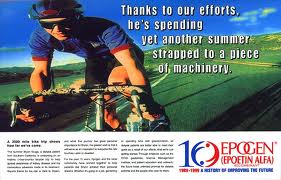
Even more ironic is the fact that most sporting companies that sponsor competitions do claim an unfair advantage from using their products. In essence they are claiming that their products work like doping, i.e. that they will make you stronger, faster, more fatigue resistant, let you recover better, and what have you. If any of these claims really held water, their products would quickly end up on the list of banned products.


I suspect it is the withdrawal of sponsorship that really frightens UCI. Unlike other sports that are held in stadiums with spectators paying for seating, cycling is almost totally dependent on sponsorship and TV. That is one reason why doping is much less of an issue in baseball, football or hockey. The owners of stadiums know the fans care very little and they will keep coming no matter what. Tour de France organizers are much more worried about the media. When German TV stations threatened to pull the plug a couple of years ago because "they were not interested in seeing trials of pharmaceutical products," the Amaury Sports Organization quickly responded.


However the reasoning goes, one thing is for sure. Cycling is in a very sorry state of affairs. Someone better fix this sooner than later. Unfortunately I suspect this is one of those areas where technology will not provide a good solution. Let's hope we find out about that before it does irreparable damage to the sport.

Friday, May 21, 2010

Doping

Once again the sport of cycling is being rocked by another doping scandal. Although the Floyd Landis' accusations made front page news in the mainstream US media yesterday, it seems most of the amateur cycling community prefers to ignore it. And who can blame them? Doping is a hot potato and it is a sore spot. So much so that you can't even joke about it anymore.

Floyd's claims are by no means unique or new. He is saying what others have said before, some as recently as a few months ago, that the use of performance-enhancing substances is rampant in the peloton. But this time, the messenger and his past exploits may overshadow the message. Furthermore, in naming Lance and Bruyneel, Floyd has ensured that his message would gain high visibility but also draw attention to his, rather shaky or shady, personal past.

Yet Floyd is not the first one to point the finger at Armstrong. Nor is he the only non-Frenchman to do so. (Americans of course like to believe that the French would secretly enjoy bringing down Lance, while they seem to forget that the fortunes of Lance and the Tour de France are now willy-nilly intertwined and symbiotic). If I remember correctly, the honor of being the first insider to point at Lance, goes to Frankie Andreu, who was once a beloved American cyclist, but is now all but forgotten (and tarnished). But then again, Frankie never won the Tour or did anything as spectacular as Floyd.

It is of course easy to fault Floyd and brand him as a cheater who never really won but instead stole victory by illegal means. But that would be closing one's eyes to the many documented reports that clearly show Floyd was a very capable and fit cyclist, who was certainly strong enough to win the Tour without performance-enhancing substances. Unfortunately since his return from a 2 year suspension, Floyd's performance has been substantially sub-par, which makes it all the more easy to claim that he only won because he applied testosterone patches to his privates.

Although I believe in the power of pharmaceuticals I also know that such dramatic improvements are out of the question. No amount of HGH, steroids, EPO, and-or other concoctions is going to make an average Cat 1 racer into a Tour de France winner. I would even go as far as claim that the performance-enhancing power of most substances remains unproven.

Although there are some data on the short term benefits of HGH and EPO, and possibly on the long benefits of steroids for things such as weight lifting, sprinting, and hitting home runs, the data on aerobic endurance performance are not there. While it seems logical that to assume that these substances should work, and while all the physiological and medical knowledge points us in that direction, this remains far from proven.

Just a little bit of experience with drug trials for regular (so-called ethical) pharmaceuticals should be enough to convince anyone that trying to predict drug efficacy remains akin to trying to predict the future. While EPO may well help someone win a time-trial, its long term benefits are unknown, and it would not surprise me in the least if one found that the long term effect is nil or even negative.

Unfortunately, from a scientific perspective, the current attitude towards drugs and sports effectively precludes any serious study of the matter. Although WADA occasionally studies or supports studies that look at short term benefits (a recent study showing HGH could improve sprinting performance comes to mind), such studies are too few and far between to really make a difference.

Once again, experience from real life clinical trials shows that large studies, involving thousands of persons and running over several years are needed to disentangle such matters. What is really ironic is that such large scale testing appears to be happening right now -all indications are that large scale doping in professional sports has been going on for decades now, and continues to this day- but without the benefit of scientific data gathering and analysis.

One can only lament the huge missed opportunity here.