Showing posts with label paris-roubaix. Show all posts

Monday, April 11, 2011

By the seat of their pants

The infamous and classic Queen of the Classics had many memorable moments this year. First we saw Tommeke standing all alone in Arenberg looking forlorn with his flat rear wheel while the whole pack raced by. Not too long after that an official car blocked the Quickstep vehicle that was trying to pace Tom and friends back into the race. Then on a further stretch of cobbles, a rider crashed in front of Boonen and Tom hit the deck and that was that for 2011.

The beginning of the end

Fabian and Husovd barely missed a motorcycle that messed up their rhythm while they were in hot pursuit of Vansummeren. Well, maybe Fabian was chasing and Thor only hung on for good measure.

Cancellara misses motorcycle


At least there were no trains this time around.


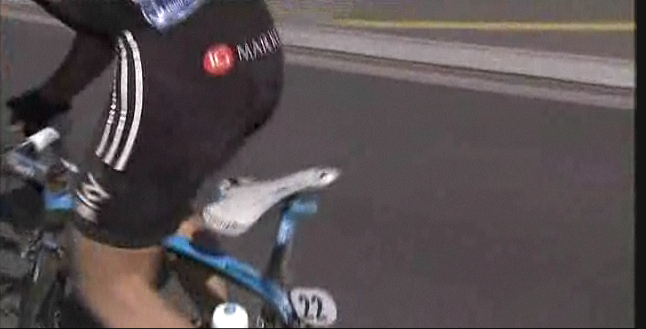
Earlier we heard that Allesandro Ballan faces prosecution in Italy in another major doping sting. Also implicated is his compatriot Damiano Cunego, who just won the Tour of the Apennines.  And finally we witnessed Kurt Arvesen riding a good 20 km with a loose saddle. Don't try this at home.


Crooked!

Sunday, April 10, 2011

Vansummeren wins!

A brief update today:
You probably already know that Johan Vansummeren won the 109th running of Paris Roubaix. I would have preferred Tommeke to match "Monsieur Paris-Roubaix," Roger De Vlaeminck,  but at least it is a Belgian victory. Kudos to Peter van Petegem for teaching the Garmin boys, and although he may have preferred Thor, Vansummeren is in some ways even better. And Thor did play his part and block. Vansummeren was so ecstatic after the race, he asked his girlfriend to marry him. Other shots posted on Twitter show Vansummeren drinking champagne with Peter and his family.

A younger Johan

Monsieur Paris-Roubaix in his golden days

Superswiss Cancellara found out what it is like to have to do all the work of bridging. He was in many ways in the same situation Tom was in last year.

As for Quick-step, it is a pity they hit the cobbles. First Tom flatted in Arenberg and then he crashed. I hope Tom recovers quickly.

More later.

Saturday, April 9, 2011

The King's appendage

While the cycling world is anxiously awaiting the verdict of tomorrow's Hell of the North, aka the Queen of the Classics, or -for those romantically inclined- Paris Roubaix, stateside, marathon fever is about to grip endurance racers with the upcoming 115th running of the Boston marathon. And so it is, when events of this magnitude are within reach, that historians go delving into the archives and cubbyholes to find tidbits of ancient lore that add luster and shine to these affairs.

The goal on Boylston Street

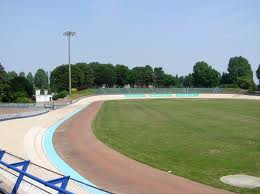
Roubaix velodrome

The marathoners love to go as far back as Ancient Greece, when a runner named Pheidippides or Philippides ran from the enclave of Marathon, where an epic battle had just taken place, to Athens, to tell the good citizens of that town that the Greeks had won. The runner, whomever he was, or whatever his name was, ran the entire distance, which, depending on how he choose to go, measured between 35 and 40 kilometers without stopping. Then as he reached the wise Athenians, and uttered his victorious Νενικήκαμεν, he collapsed and died. Hollywood could not have done better especially since the entire affair is more likely than not hearsay.

Contrary to popular belief the marathon was not a sporting event in Ancient Greece or at the Greek Olympics. The Greeks knew better than to run that distance in competition. Without helicopters, roving TV cameras, and constant internet updates it would have been boring as hell to watch.

The marathon is a modern invention, and like Paris Roubaix, it was invented by a Frenchman who was eager to find an event suitable for his newly proposed Olympic Games of the Modern Era. Nobody was really sure what distance to use, but 40 km seemed like a nice round and metric number with some historical justification.

When the marathon moved to London for the 1908 Olympics, the English thought it would be nice to add a little extra so the King could watch the start of the event from his palace balcony. And so it was that 2.195 kilometers was added to the race. The official distance then became 42,195 meters or 26 miles and 385 yrds (close enough to print bumper stickers that read 26.2).

But perhaps the Kings add-on would not have prevailed had it not been for the type of finish that later put Ironman on the map. In that famed 1908 Games, Italian Dorando Pietri entered the finishing lap at the Roubaix velodrome stadium, struggling to make it to the line. He was helped by officials who propped him up and carried him in, as American Johnny Hayes was bearing down on him. Pietri was later disqualified but the Queen was so taken by this incident that she gave Pietri a gold cup the next day. This made-for-TV moment, that preceded Julie Moss's eerily similar Hawaiian crawl in February of 1982, started a worldwide marathon fever. Julie had to settle for David Letterman as America has no queen.

The Hawaiian crawl

I am sure you will all be keeping your fingers crossed and hope that trains will run on time in Northern France.

Paris-Roubaix train incident

I also hope you will be rooting for Tommeke. Hopefully he won't have to crawl over the line to hold off the Swiss superman (of Italian descent) Cancellara.
Friday, April 8, 2011

Third wave and cobblestones

Following the Women's Movement and Holy Spirit innovators, the Boston Marathon is now also adding its own Third Wave. The Third Wave or Wave 3 as it is know over there in New England, will leave the town of Hopkinton at 10:40 AM and wear blue bib numbers that read 18,000 or higher.

All of this is part of the rather sudden explosive growth in popularity of America's Oldest Marathon. The Boston marathon now sells out almost as quickly as an Ironman.

Gratuitous bragging
The 2012 registration procedures have changed to reflect that reality, giving registration time bonuses to runners who best the required entry times by 5, 10 or 20 minutes, in what is known as a "rolling admission." For 2013, organizers just decided to cut 5 minutes of the qualifying times that were standard up until now. That should convince naysayers who believe that "Americans are out of shape and the situation is getting worse every year."

I for one will not attend this year's event, although I am happy to boast that in previous editions (forgetting the 2010 Boston disaster) I was able to best my qualifying time by more than 20 minutes and would thus have qualified for the bonus. The reason I am not attending is that I feel quite good having run three-in-a-row and I will save myself the airfare and the environment the CO2 of going there.

More bragging...

In Europe meanwhile everyone is getting ready for the infamous cobbles of Paris-Roubaix. World champion Tor Husovd, who would like to win the event wearing a rainbow jersey, said doing so would be as simple as following Alberto Contador up Alpe d'Huez.

Peter van Petegem, the veteran winner of the event and a special adviser to Garmin thinks "it is all in the head." Echoing a line we have heard many times from Ironman swimmers, Van Petegem thinks that to win Paris-Roubaix, you have to fall in love with the cobbles (Ed. ironman swimmers of course need to fall in love with the water).

So far though, Peter's efforts and Garmin's results have not impressed anyone. Far from it, the Belgian press has been raking Garmin and its well-known adviser over the coals for their non-presence in the Ronde and other early season races. The dream team has so far disappointed everyone who follows these matters.

Thursday, April 7, 2011

Ducktape (duct tape?) Age

Historians will tell you that in 1942, humanity effectively exited the Iron Age and entered the Ducktape Age. Some English scholars may quibble about the spelling of the name for this new era, some preferring Duck tape, Duck Tape or even Duct Tape instead, but I will refrain from entering into a discussion over such subtleties.

It was also brought to my attention that the People Down Under -for whom everything including history is upside down- use the term Duct Tape to refer to another, far less important type of sticky tape that is used in the preparation of vegemite, the ultimate performance-enhancing substance for endurance racers.

Ducktape prototype for the Golden Gate

Anyone watching the hugely popular show MythBusters will know that every invention known to man can be improved upon by Ducktape and that includes power meters. I remember that at the USAC coaching meeting, Hunter Allen told us that some athletes do better when you cover their power meter readout with Ducktape, so as to take away a distraction.

And so it is that due to my recent crashes I was forced to use the almighty Ducktape to temporarily improve my helmet in the following fashion:

Don't try this at home!

Now, before you grab your quill and ink canister to write me an email about safety, responsibility and other outrages related to this fix, let me remind you that NASA used Ducktape to fix the airflow in the infamous Apollo 13 incident, and later again for Apollo 17 to fix their moon buggy. Anything good enough for NASA is good enough for me.

Ducktape fender on the moon
On second thought, maybe Ducktape was the reason Apollo 18 failed! After watching the trailer, I did order a replacement helmet forthwith.

And for your further enjoyment, here are some daguerrotypes illustrating the latest petrol prices:


Up and up


I have heard a rumor that due to these unreasonably high fuel prices, competitors in the upcoming and infamous Paris-Roubaix race will be using human powered bicycles for propulsion. I wonder how many of these will sport Ducktape enhancements!

Tuesday, April 5, 2011

Another brick in the wall

Or at the very least another cobblestone in the window. That is what Nick Nuyens meant when he said winning the Ronde is for life. And I am sure that if you go the Ronde van Vlaanderen Centrum in Oudenaarde, you will see another cobblestone to the left of that big Swiss one that reads Nick Nuyens 2011.

Winners immortalized in cobblestone
Of course if you were to win more than once, you won't get a second cobble. They will just add your second (or third) victory year to your existing monument, as seen below:

One stone is all you get, no matter how often you win!
Meanwhile the Ronde 2011 is history and all eyes are now focused on the Queen of the Classics, aka Paris-Roubaix. Although the emphasis shifts to France, it is a part of France known as French Flanders that historically belonged to the County of Flanders, and where many names still betray its Flemish roots.

But before that happens, all eyes will turn to the Scheldeprijs Vlaanderen, aka De Grote Scheldeprijs on Wednesday, where Quick-Step will be seeking revenge by bringing out all their sprinters. The line-up includes Tom, Chicci, Ciolek, Keisse, Robert, Stauff, Steegmans, and Kevin Van Impe. The last time Quick-Step won the race was in 2006, when Tom was wearing the world champion jersey. Since then Mark "the missile" Cavendish has won it twice, Petacchi once, and last year's race was won by Tyler Farrar.

Belgian classics legend Johan Museeuw retired after finishing the 2004 edition of the Scheldeprijs, (then held after Paris-Roubaix), that was won by Tom Boonen. Museeuw is the only major classics star who never won the event, finishing second twice in 1992 and 1997.

Friday, October 1, 2010

Cobbles


Nearly all races in Belgium feature an attraction that is foreign to American riders, especially those from the left coast: cobblestones. And while a majority think that cobbles are a remnant of the middle ages, most cobblestone stretches in Belgium were laid down very recently indeed. Even the cobbles of legend, such as those covering the infamous Koppenberg were re-installed as recently as four-five years ago.

Cobblestone roads were popularized by the Roman Empire and some of the old Roman roads are still in existence today. The Via Appia or Appian Way was one of the earliest and most important roads of the ancient republic. It connected Rome to Bridisi and parts of it have been preserved to this day. None of the cobblestone stretches in Flanders or along the Paris-Roubaix course (which is in French Flanders) have that kind of history.

In recent years cobblestones have become a very popular material for paving town centers and pedestrian-only streets. The stones form natural rumble strips and cause drivers to instinctively slow down. The increased noise also alerts pedestrians to oncoming traffic. Most of the newer cobblestone roads are in fact paved with setts or Belgian blocks instead of real cobbles. A sett is a rectangular quarried or shaped stone and it has a more regular shape and form than naturally occurring cobbles. Setts also present a smoother surface than real cobbles.

In California, cobblestone roads are often equated with bad pavement, and quite a few races that feature stretches of bad pavement try to make a connection to Paris-Roubaix, the temple of cobbles. Such is the case for the Copperopolis Road Race and the Leesville Gap race in Northern California. But while Paris Roubaix, and the Ronde van Vlaanderen are famous for bad sections, there is a rather significant difference between a cobblestone road and an gravelly-asphalt road in poor condition.

First of all, even newer cobblestone roads without potholes present an obstacle that test both a rider's skill and their fitness. The surface is uneven and has a higher rolling resistance than an asphalt road. The vibration is constant and takes its toll, especially on inexperienced riders. Cobbles can get very slippery when wet or very dry and dusty. That effect is often accentuated by a rounded cross section with a distinctly elevated center or crown.

Riding cobblestone roads is easier when using a bike with a longer wheelbase and a more relaxed geometry. It also works better with relatively lower air pressure.

Both automatically favor bigger riders. The increased rolling resistance also favors more muscular types over light and skinny climbers. Riding cobbles works best in a big gear, something that is counter-intuitive to beginners. Also counter-intuitive is the fact that you need to relax your upper body when riding cobblestones. Mountain bike riders often do quite well riding on cobbles because the optimal riding style is very similar to that of cross country racers.

If you do what most people naturally do, i.e. ride a smaller gear and hold on for dear life, the cobbles will punish you in no small measure. Your wrists will hurt, your arms will go numb, and your teeth will feel like they are falling out. You won't be able to concentrate on the road because the shaking will make it hard to focus your eyes, while your helmet and glasses may dance all over your head. When excessive these are symptoms indicative of bad technique, although perfect technique will not completely abolish the punishment you invariably take.

Cobbled climbs add another challenge. The key here is to watch your weight distribution and make sure you keep traction on your back wheel. Once again this is similar to mountain biking and it is something road bikers are not familiar with.

When faced with wretched cobblestone roads, such as those in Paris-Roubaix or some of the worst sections along the Ronde, you have two options. The first is to ride beside the road, in the gutter. It often looks the most attractive and beginners naturally choose this option. Be aware though that it is the path of trouble. In many spots, the gutter won't be free as spectators or barriers will block access. You will then be forced onto the cobbles at the worst possible places. Either way, riding off to the side is a sure recipe for flat tires.

The best way to ride bad roads is to ride on the crown. It is more punishing than riding the gutter but it is far safer and it is the best way to avoid flats or other mishaps. Unfortunately it is only available to those willing to ride in the front. But the trade-off is more than worth it and if you watch Paris-Roubaix you will see that that is where the winners ride.

If you plan to do a race with cobbles -nearly all races have some- be sure to check them out beforehand, lest you'll be in for a big surprise. Remember that even the nicest looking cobbles are a serious obstacle and plan accordingly. Be especially aware of the transitions to and from cobbles and the cobblestone turns. That is where most of the mayhem takes place. Also remember that the local kids won't slow down and if you do, you are likely to get into a crash right then and there.


Sunday, April 12, 2009

Tommeke threepeat

An impressive third victory for Tom Boonen in Paris-Roubaix today. He devastated the field, rode everyone off his wheel. Spectacular racing if I ever saw some. You can see parts on sporza.be under wielrennen (cycling).

I ran 14 miles today, a long loop out to Montclair to Joaquin Miller. Up JM to Skyline and then back home. A lot of climbing to be sure. Took 2:11 approximately. Boston, I am ready.

Yesterday I rode 35.5 miles on the Specialized after we came home from Copperopolis, where Alistair got 4th place. It was also the first time I beat someone down Wildcat--and a good rider too! 
On Friday I rode 42 to Castro Valley and back. I hit 269NP watts on my ergomo. (The NP is proprietary algorithm to account for intensity. I find it works well to predict how much effort I put in. 269 is one of the highest readings I ever scored for the distance).

Thursday I ran 7 miles in the rain. Not fun, but good prep for Boston I guess. And on Wednesday I swam 160 laps fast (approx. 3,000 meters). Tuesday 1:15 minutes on rollers, burning approximately 1,155 calories (It rained).